


Paint numbering systems are standardized alphanumeric codes that identify a paint’s exact pigment composition, lightfastness, formula, and quality grade. Every tube, can, or swatch carries these codes, and they tell you far more than any marketing name ever could. Color names like “Cerulean Dream” or “Autumn Blush” are invented for sales appeal. The actual code behind that name is what instructs a mixing machine or guides your palette decisions. Learning to read these codes is the single most reliable skill for consistent color selection across art, DIY, and restoration projects.
How to understand paint numbering systems: pigment codes, lightfastness, and series
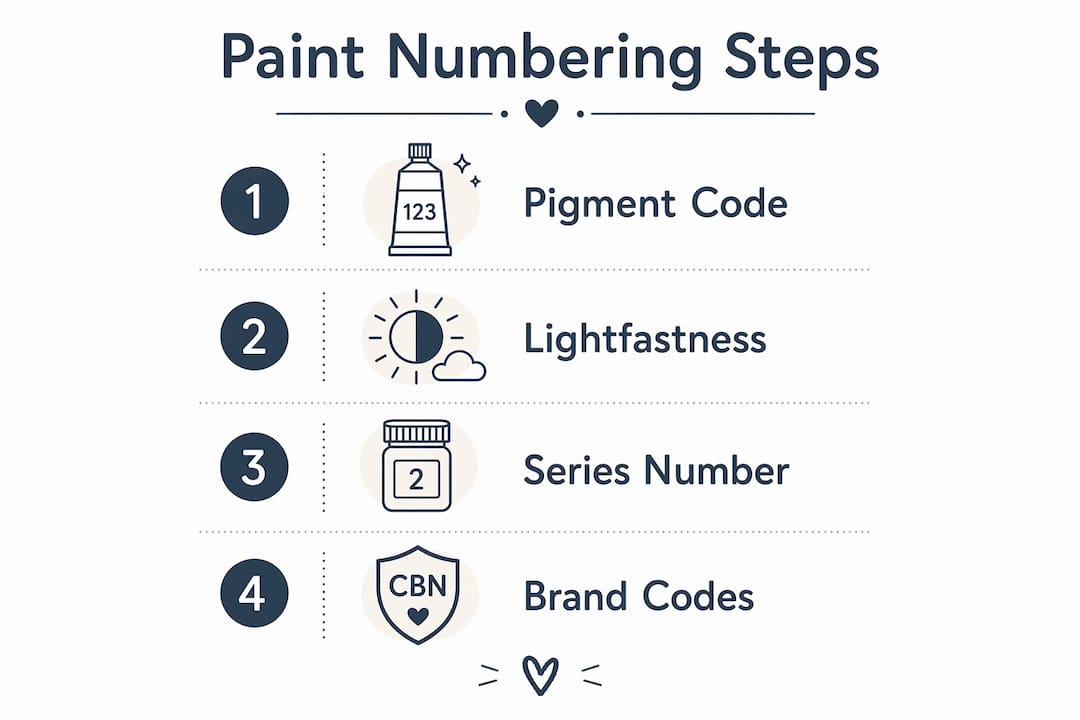
Paint numbers represent three distinct layers of information: what pigment is inside, how long the color will last, and how much the paint costs relative to other colors in the line.
Pigment codes reveal what is actually in the tube
Pigment codes are the most critical piece of information on any artist paint label. They follow a universal format: the letter “P” plus one or two letters indicating color family, followed by a number. Pigment codes like PB29 identify the exact chemical compound inside the paint, regardless of what the manufacturer calls it. PB stands for Pigment Blue, PY for Pigment Yellow, PR for Pigment Red, and PW for Pigment White. PB29 is Ultramarine Blue. PY150 is Nickel Azo Yellow. These designations are set by the international Color Index, not by individual brands.
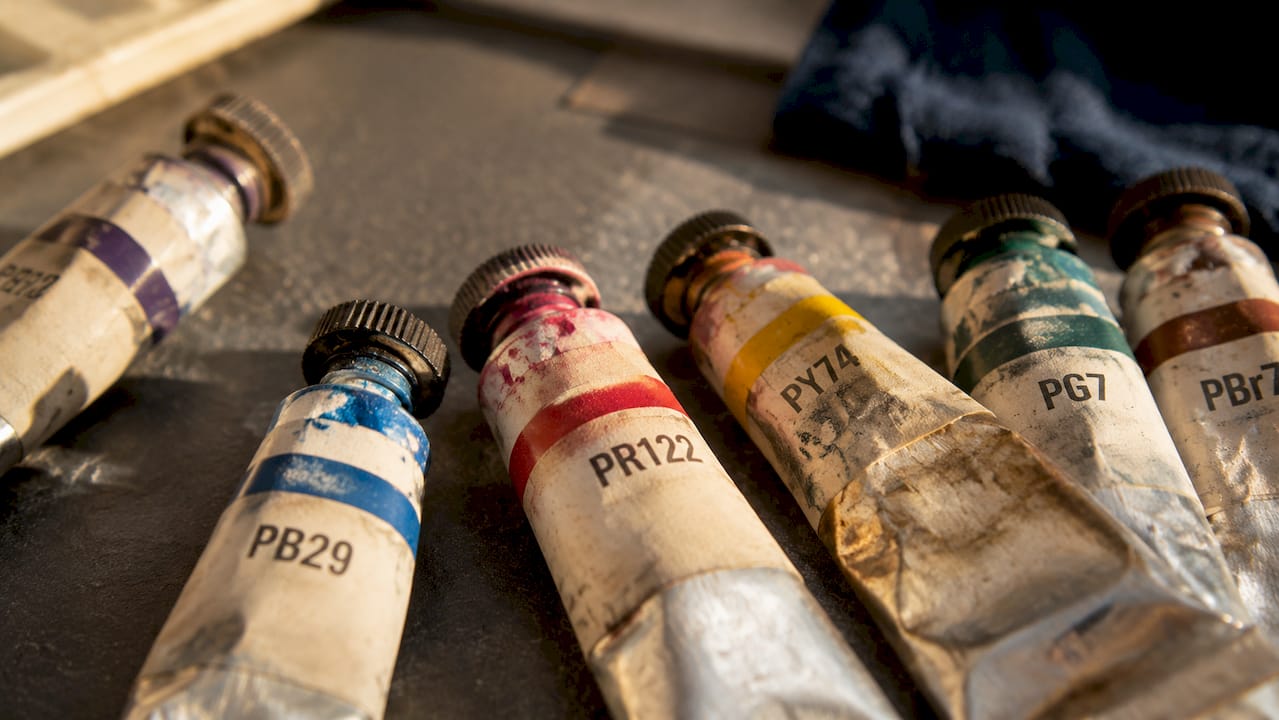
A single-pigment paint carries one code, such as PB29. A multi-pigment paint carries several, like PB29 and PR122. Multi-pigment paints mix less cleanly because each pigment reacts differently with other colors. Artists who understand this avoid muddy results by choosing single-pigment paints for primary mixing.
Pro Tip: When two paints from different brands share the same pigment code, they will mix predictably together, even if their color names are completely different. This is the real value of decoding paint numbers.
Lightfastness ratings determine how long your work lasts
Lightfastness measures how resistant a color is to fading when exposed to light. Lightfastness ratings run from I to IV: Rating I means Excellent, with a lifespan exceeding 100 years. Rating II means Very Good, also around 100 years. Rating III means Fair, lasting 50–70 years. Rating IV is Fugitive, fading in as little as 15–20 years. Any paint you intend to display or sell should carry a Rating I or II. Rating IV colors are fine for practice or studies, but they will fade noticeably in a framed piece exposed to daylight.
Daniel Smith, one of the most respected names in professional watercolor, prints lightfastness ratings directly on every tube. This transparency is the industry standard for artist-grade paints, though student-grade lines often omit this data entirely.
Series numbers tell you what you will pay
Series numbers on artist paints run from 1 upward, with Series 1 being the most affordable and higher numbers indicating rarer or more expensive pigments. Cadmium-based paints typically sit in Series 4 or 5 because cadmium is costly and regulated. Titanium White usually lands in Series 1. Series numbers are brand-specific and do not translate across manufacturers, but within a single brand they give you a fast read on relative cost before you check the price tag.
Do paint codes change between brands and industries?
The short answer is yes, and significantly. Paint codes are not universal across manufacturers or even across product lines within the same brand.
How brand-specific codes work in practice
Paint manufacturers use alphanumeric codes to reproduce exact formulas, because color names alone carry no technical meaning. Sherwin-Williams formats its codes as “SW” followed by four digits, for example SW7029 for Accessible Beige. Benjamin Moore uses a different numeric structure entirely. Dodge automotive paints use three-character codes like PX8. None of these systems are interchangeable.
The table below shows how code formats differ across industries:
| Industry | Brand | Code Format | Example |
|---|---|---|---|
| Interior paint | Sherwin-Williams | SW + 4 digits | SW7029 |
| Interior paint | Benjamin Moore | 4-digit number | 2163-40 |
| Automotive | Dodge | 3 characters | PX8 |
| Automotive | Jaguar | JA prefix + Glasurit number | JA/HAJ + supplier code |
| Artist paint | Daniel Smith | Pigment code + series | PB29, Series 2 |
Color codes also vary by product line and finish within the same brand. A color coded under one finish in a premium line will carry a different code in a standard line, even if the two colors look identical in a swatch. This is the most common trap for DIYers trying to touch up a painted wall years later.
Automotive paint codes add another layer of complexity
Automotive paint codes are the most layered of any industry. Jaguar’s factory codes use a “JA” prefix alongside separate Glasurit supplier codes, meaning a restorer needs both to source the correct paint. Two-tone vehicles require separate code identification for upper and lower body sections. Misreading a two-tone layout is one of the most common errors in vintage car restoration, producing a mismatch that is obvious in direct sunlight.
Pro Tip: For automotive projects, always photograph the code plate before ordering paint. Code plates are often located on the door jamb or firewall, and the codes fade over time on older vehicles.
What do the numbers on paint mixing cups mean?
Paint mixing cups carry ratio markings that control how much paint, hardener, or thinner goes into each mix. Getting these ratios wrong affects both the finish quality and the drying performance of the paint.
Here is how to read and use them correctly:
- Identify the ratio format. Mixing cup ratios like 1:1 or 2:1 represent parts by volume. A 2:1 ratio means two parts paint to one part hardener or thinner.
- Pour to the marked lines. Most mixing cups print graduated lines on the side corresponding to common ratios. Pour the first component to the first line, then add the second component to the next marked line.
- Scale to your project size. The ratio stays constant whether you are mixing 4 fluid ounces or 16. The lines on the cup scale proportionally, so you do not need to calculate independently.
- Check viscosity before applying. Mixing ratios directly influence final consistency and drying performance. A mix that is too thin will run. A mix that is too thick will drag and show brush marks. Dip a stir stick and watch how the paint flows off. It should fall in a steady ribbon, not drip or pour like water.
- Record your ratio for every batch. Write the ratio and component brands on a piece of tape stuck to the cup. Consistency across coats depends on replicating the exact same mix each time.
Pro Tip: Never estimate ratios by eye. Even experienced painters who skip the cup markings produce inconsistent results across coats, especially with two-part epoxy or urethane finishes.
How do you read paint labels on tubes, cans, and swatches?
Reading a paint label correctly means knowing where to look and what each element actually tells you.
- Find the formula code first. Paint codes on cans appear on lids or side stickers, labeled as “Color Code” or “Formula Number.” On artist tubes, the pigment code appears near the bottom of the label, often in small print. On swatches, the code is printed on the back or along the edge.
- Separate the marketing name from the formula. “Cobalt Blue Hue” and “Cobalt Blue” are not the same paint. “Hue” indicates a pigment substitute, usually a cheaper alternative that mimics the color but behaves differently when mixing.
- Read the pigment prefix letters. PY means Pigment Yellow, PB means Pigment Blue, PR means Pigment Red, PO means Pigment Orange, PV means Pigment Violet, PBk means Pigment Black. These prefixes appear on artist-grade paint tubes and tell you the color family of each pigment in the formula.
- Cross-check the product line and finish. A code from a matte finish line will not reproduce correctly in a satin or gloss finish, even from the same brand. Always verify that the code matches both the product line and the finish you are replicating.
- Keep a record of every code you use. Photograph the label or write the full code in a project notebook. Color names fade from memory. Codes do not change.
Pro Tip: Most people overlook the finish specification when ordering touch-up paint. The pigment formula may be identical, but a matte code mixed into a satin base will produce a visible sheen difference on the wall.
Key takeaways
Paint numbering systems are the definitive tool for accurate color selection, and pigment codes, lightfastness ratings, and formula numbers together give you complete control over any painting project.
| Point | Details |
|---|---|
| Pigment codes over color names | Use codes like PB29 or PY150 to identify true pigment chemistry and predict mixing behavior. |
| Lightfastness ratings matter | Choose Rating I or II for any work meant to last; Rating IV colors fade within 15–20 years. |
| Codes vary by brand and finish | Always verify the code against the specific product line and finish, not just the color name. |
| Mixing ratios control quality | Follow cup ratio markings precisely; a wrong ratio affects drying, consistency, and final finish. |
| Record every code you use | Photograph or write down formula codes from every project to replicate colors reliably later. |
Why paint codes changed how i approach every project
I spent years matching colors by eye and by name, and I was wrong more often than I care to admit. The shift happened when I started treating pigment codes as the primary language of paint, not the color name printed in large type on the label.
The most instructive failure I had was with a multi-pigment tube labeled “Sap Green.” I bought the same name from three different brands for a landscape series. Each one mixed completely differently because each carried a different pigment combination. One used PY150 and PG7. Another used PY3 and PBk7. The results were not even close to consistent. Once I started reading pigment codes instead of names, I could predict exactly how each color would behave on the palette.
The same principle applies in automotive and interior work. I have seen DIYers repaint a wall with the correct color name and end up with a visible patch because the finish code was different. The color looked right in the can and wrong on the wall. Codes are not bureaucratic detail. They are the actual instructions.
My advice for hobbyists is to treat the numbering system as a creative tool, not a technical barrier. Once you know that PB29 is always Ultramarine Blue regardless of the brand name on the tube, you gain the freedom to shop across brands, compare prices, and mix with confidence. The numbers give you control that color names never can.
— Daniel
Start painting with confidence using Craftybynumbers
Understanding paint codes is the foundation of better creative work. Craftybynumbers takes that foundation and builds something genuinely enjoyable on top of it.

Craftybynumbers has helped over 120,000 customers move from color confusion to confident creation. Each kit arrives with a pre-printed canvas, numbered sections, and precisely matched acrylic paints, so the color selection work is already done for you. The numbering system on every Craftybynumbers canvas connects directly to the included paints, making the process clear from the first brushstroke to the last. Whether you are a first-time painter or an experienced hobbyist, explore the full kit collection and find a design worth displaying.
FAQ
What is a pigment code on a paint tube?
A pigment code is a standardized identifier like PB29 or PY150 that names the exact chemical pigment inside the paint. It is set by the international Color Index and appears on artist-grade paint tubes regardless of brand.
How do i find the paint code on a can?
Paint codes on cans are printed on the lid or a side sticker, labeled as “Color Code” or “Formula Number.” They are alphanumeric and more reliable than color names for exact color replication.
Why do the same color names look different across brands?
Color names are marketing labels with no technical standard. Two brands can use the same name for colors built from completely different pigments, which is why pigment codes and formula numbers are the only reliable way to match colors across manufacturers.
What does a 2:1 ratio mean on a mixing cup?
A 2:1 ratio means two parts paint to one part hardener or thinner, measured by volume using the graduated lines on the mixing cup. Getting this ratio right controls the paint’s consistency, drying time, and final finish quality.
What is lightfastness and why does it matter for artists?
Lightfastness measures how resistant a paint color is to fading under light exposure. A Rating I color lasts over 100 years, while a Rating IV color can fade in as little as 15–20 years, making the rating critical for any work meant for long-term display.
0 comments