

Here are party-ready craft stations, grouped by age, that need low prep and leave minimal mess. Each idea below comes with a quick how-to, a time estimate, and a note on what makes it a good take-home favor. You’ll also find setup timing, a supplies checklist, cleanup tricks, and simple guidance for choosing kits like those from Crafty By Numbers when you want a station that runs itself.
TL;DR:
- Guided paint-by-numbers kits provide a low-stress, structured activity that ensures children of all abilities finish a recognizable, proud art piece.
- For preschoolers, crafts like handprint animals and cupcake-liner flowers take minimal time and help prevent frustration due to their simplicity and safety.
- Rotations should be scheduled for 8 to 10 minutes for preschoolers and 15 to 20 minutes for older children to maintain engagement and efficient use of party time.
- Setting up a few adaptable stations and preparing a clear timeline helps keep the party organized, with a focus on quick cleanup and minimal mess.
- Using pre-printed templates and reusable supplies reduces prep time and budget, making guided projects practical for large groups or themed parties.
Table of Contents
- Kids Birthday Craft Ideas Grouped by Age
- How to Set Up Craft Stations and Run Rotations
- Supplies, Printables, and Budget-Saving Shopping Tips
- Containment, Drying, and Cleanup Tricks
- Why Guided Projects Work So Well at Kids’ Parties
- Adaptations for Kids With Special Needs or Varying Abilities
- Craft Ideas for Common Birthday Party Themes
- Why Party-Ready Beats Pinterest-Perfect
- Run a Paint-by-Numbers Station With Crafty By Numbers Kits
- Sources
- FAQ
Kids Birthday Craft Ideas Grouped by Age
Matching a craft to a child’s attention span matters more than picking the “coolest” project. A five-year-old and a nine-year-old at the same table will get bored or frustrated in completely different ways, and grouping ideas by age is the single biggest predictor of whether a station runs smoothly or falls apart in the first ten minutes, a pattern seen across top-ranking craft roundups.
Preschool (ages 2 to 4)
- Handprint animal cards. Press a hand into washable paint, stamp onto cardstock, and add googly eyes once dry. Prep level: low. Time: 10 minutes. Needs adult help for every stamp, but the cards double as thank-you notes.
- Cupcake-liner flowers. Flatten a paper liner, glue a pom-pom center, tape to a craft stick. Prep level: low. Time: 8 minutes. No sharp tools involved, which makes it the safest station on this list.
- Sticker collage banners. Pre-cut triangle flags, let kids fill them with stickers, string together at the end. Prep level: medium (cutting flags ahead of time). Time: 10 to 15 minutes.
- Paper plate masks. Punch eyeholes in advance, let kids color and glue on yarn hair. Prep level: medium. Time: 12 minutes. Skip small buttons or beads here since choking hazards are a real concern under age three.
Two toddlers can often share one canvas or template at this age, since neither will finish a full project solo anyway.
Ages 4 to 6
- Mini canvas splatter painting. Give each child a small canvas, a spoon, and thinned washable paint to flick or drip. Prep level: low. Time: 10 minutes, plus drying time. Lay down butcher paper first.
- Paper crowns. Pre-cut crown bases, kids decorate with markers, gems, and stickers, then staple to fit. Prep level: medium. Time: 12 minutes. Great as a favor kids wear home.
- Pom-pom necklaces. String pom-poms and beads onto yarn with a taped end to act as a needle. Prep level: low. Time: 10 minutes. Watch for kids who still mouth small objects.
- Decorated treat boxes. Plain cardboard boxes get stickers, markers, and washi tape, then get filled with candy at the end. Prep level: low. Time: 10 minutes.
Ages 7 to 9
- Dreamcatchers. Wrap yarn around a small hoop, tie on feathers and beads. Prep level: medium. Time: 15 to 20 minutes. This one benefits from a finished sample nearby so kids know what they’re aiming for.
- Printable birthday wreaths. A free two-page printable gets cut, folded, and assembled into a door wreath, and it needs almost no adult intervention once instructions are handed out, according to a free printable birthday wreath craft. Prep level: low. Time: 15 minutes.
- Fabric collage banners. Kids glue fabric scraps and ribbon onto a canvas banner shape. Prep level: medium. Time: 15 minutes.
- Mask decorating with fabric markers. Blank fabric or paper masks get personalized designs. Prep level: low. Time: 12 minutes.
Ages 10 and up
- Guided paint-by-numbers mini canvases. A pre-printed, numbered design with matched acrylic paints gives older kids a real finished piece without the frustration of a blank canvas. Prep level: low once kits are opened. Time: 20 to 30 minutes, longer for detailed designs.
- Simple sewing or beading projects. Felt keychains or friendship bracelets with a basic stitch. Prep level: medium, needs adult supervision for needles. Time: 20 minutes.
- Sock caterpillars. Stuffed socks sewn or hot-glued into segments with felt faces. Prep level: high, needs an adult doing most of the sewing or gluing. Time: 20 minutes with help.
- Custom photo canvases. Older kids paint or embellish a canvas already printed with a simple outline. Prep level: medium. Time: 20 minutes.
Skip glitter across every age group. It sticks to hands, carpets, and cake, and washable paints, stickers, or washi tape give the same festive look without the mess.
How to Set Up Craft Stations and Run Rotations
A three-station model works well for around eight kids, since it keeps groups small enough that nobody waits long for supplies. One classroom art party built around four stations for 22 kids kept things moving with 12-minute rotations, and that pacing holds up well for home parties too, based on a documented paint party budget breakdown. Preschoolers do better with 8-minute rotations since focus drops off fast; kids 7 and up can handle 15 to 20 minutes per station.
A sample 90-minute timeline:
- 0 to 15 minutes: Arrival and a gathering activity (see the pro tip below) while guests trickle in.
- 15 to 35 minutes: Rotation one, the messiest or most drying-dependent craft.
- 35 to 55 minutes: Rotation two, a medium-complexity project.
- 55 to 70 minutes: Cake and food.
- 70 to 90 minutes: Optional third rotation or open play, plus a cleanup buffer.
Assign kids to stations by drawing names or numbers rather than letting them choose, which avoids the “everyone wants the same table” scramble. One parent helper per station of four to six kids keeps supplies flowing and hands off task, not devices.
Pro Tip: Set up a simple gathering activity, like a short story-and-draw prompt, right at the entryway so early arrivals have something to do while you wait for the group to fill out. A children’s storytelling workflow that pairs a quick tale with a drawing task works especially well here.
Supplies, Printables, and Budget-Saving Shopping Tips
A solid core kit covers most crafts on this list: cardstock or mini canvases, washable paint, brushes, glue sticks, stickers, child-safe scissors, smocks, and a designated drying area. Printables like the birthday wreath template above cut prep time to almost zero and scale easily to any group size by printing more copies.
Stretch a budget by:
- Swapping canvases for cardstock or cereal box cardboard where texture doesn’t matter.
- Buying multi-packs of paint and brushes instead of single units.
- Reusing leftover supplies from prior parties or craft kits.
- Checking large template collections or ready-made party craft guides before buying anything new.
Always choose non-toxic, washable paint and age-appropriate tools, especially scissors and small embellishments for younger guests.
Containment, Drying, and Cleanup Tricks
Trash-bag smocks and butcher paper table covers stop most damage before it happens, and a cardboard box lid under a splatter station catches drips that would otherwise land on the floor. A cheap shower curtain taped up behind a station protects walls during anything involving spray or splatter.
- Label drying trays by child’s name so finished pieces don’t get mixed up.
- Schedule the messiest, most drying-dependent craft earliest in the timeline so pieces have time to set.
- Keep paper towels and a stack of damp cloths at every station for fast wipe-downs between rotations.
- Skip small parts and edible embellishments for kids under 3, and check for allergies before any edible-decorating station.
Why Guided Projects Work So Well at Kids’ Parties
Mixed-ability groups create a real problem at craft stations: some kids finish in five minutes, others stare at a blank page. A pre-printed, numbered design solves that by giving every child the same clear path to a finished piece, which cuts down on the choice paralysis that stalls open-ended crafts.
Structured, guided activities remove the blank-page pressure entirely. A child doesn’t need artistic instinct to finish something they’re proud of, they need a clear next step, and that’s exactly what a numbered canvas provides.
Crafty By Numbers built its kits around that principle, and with over 120,000 satisfied customers, the format has proven itself well beyond hobbyists working alone at home. Each kit pairs a pre-printed canvas with matched acrylic paints and brushes, the same numbered-canvas format used in classroom and group paint-by-numbers kits designed for exactly this kind of group setting. Editorial reviewer Paula S. notes that simple adaptations, like pre-filling large background areas for preschoolers or letting two younger kids share one canvas, make the format flexible enough for a five-year-old’s birthday table and a ten-year-old’s alike. Keeping a finished sample piece nearby also gives hesitant kids a clear picture of what they’re working toward.
Adaptations for Kids With Special Needs or Varying Abilities
A craft station that works for every guest usually needs a few adjustments planned in advance, not improvised on the spot. Bigger brush handles or built-up grips help kids with fine motor challenges hold tools more comfortably, and painter’s tape borders around a canvas give a tactile edge that helps kids who are blind or have low vision stay within the workspace.
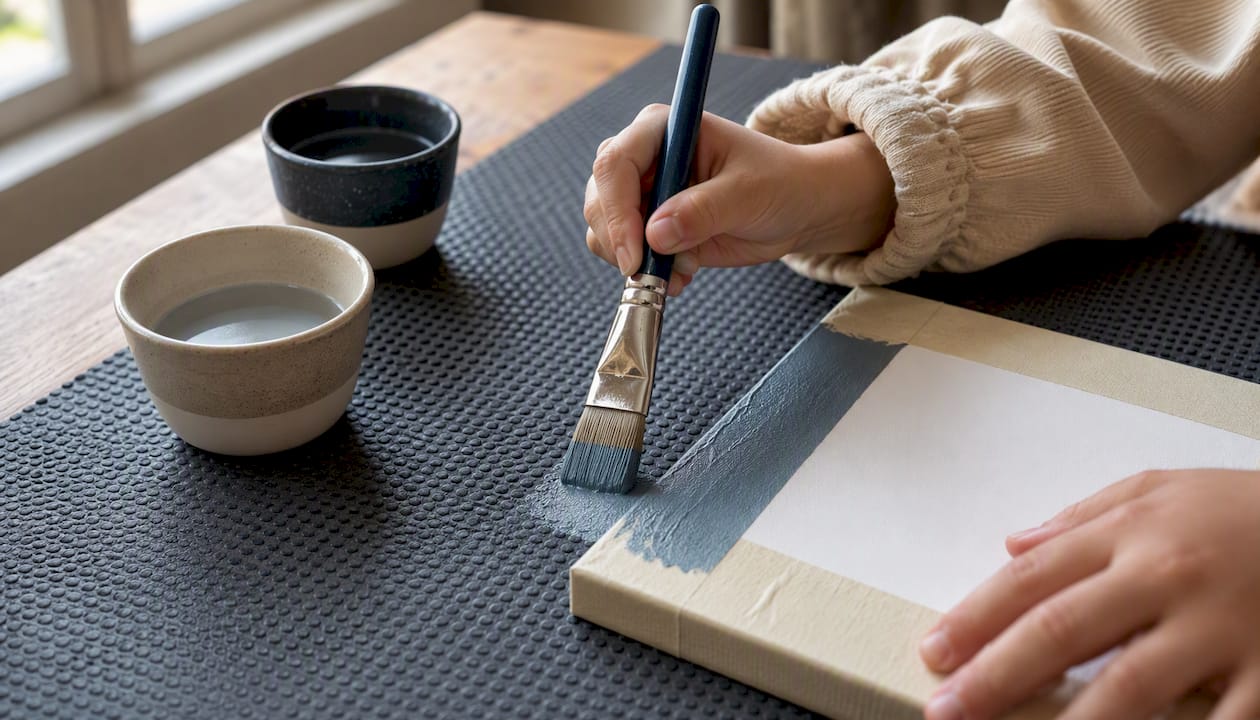
For kids who get overwhelmed by noise or crowds, set up one station in a quieter corner or a separate room, and let a parent helper know that child might need extra time or a smaller task list. Breaking a project into fewer, larger steps, like pre-cutting shapes instead of asking a child to cut them, helps kids with limited motor control finish alongside their peers instead of falling behind.
Sensory sensitivities are common, so offer a fragrance-free, texture-light option (a paper collage instead of glue-heavy slime crafts, for instance) at every station rather than as an afterthought. Kids who process instructions differently often do better with a single demonstrated example step rather than a spoken multi-step list, so showing rather than only telling helps more than repeating verbal directions.
None of these adjustments require separate supplies or a second budget. They mostly come down to planning a slightly wider range of difficulty into each station from the start, so no guest ends up sitting out while everyone else finishes something.
Craft Ideas for Common Birthday Party Themes
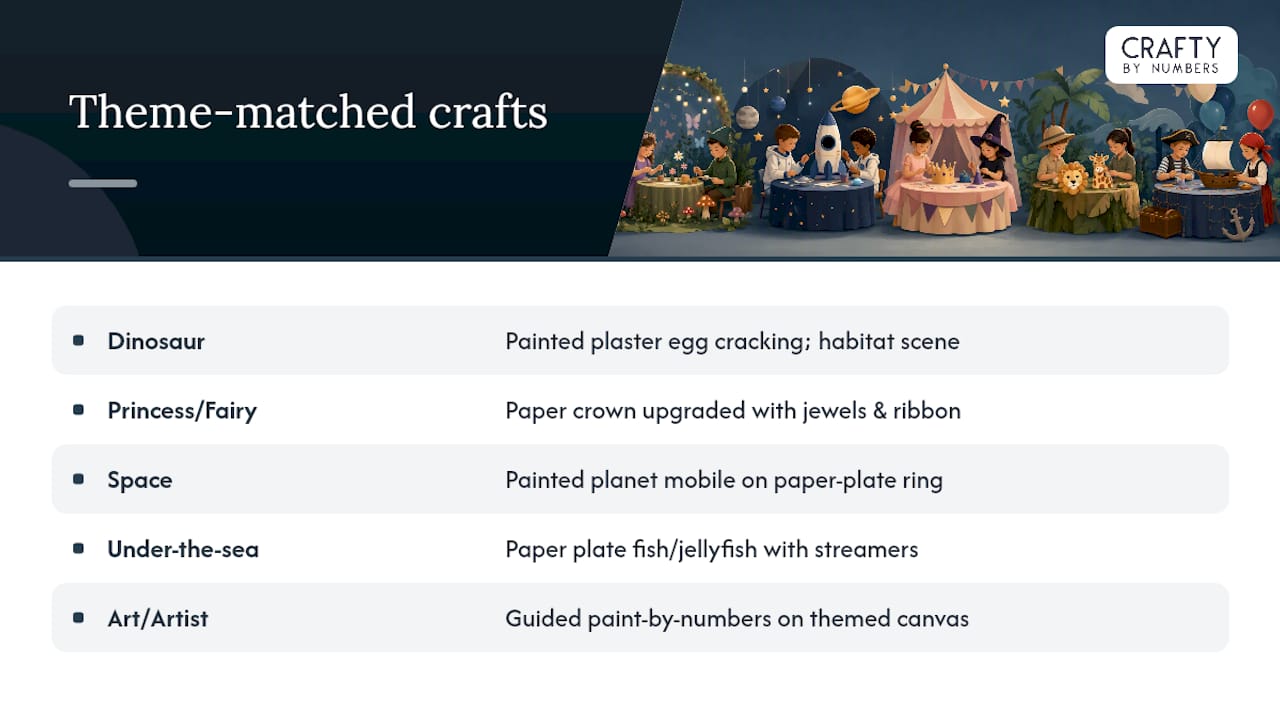
Matching a craft to the party’s theme turns a generic activity into something guests remember. A dinosaur party pairs naturally with painted dinosaur egg cracking, where kids crack open a plaster egg to reveal a small dino figure, then decorate a nest or habitat scene around it. Princess or fairy tale themes work well with the paper crown station from the 4 to 6 age group above, upgraded with jewels and ribbon for an older crowd.
Space-themed parties suit painted planet mobiles, where foam balls get painted and hung from a paper plate solar system ring, and the drying time fits naturally into an early rotation slot. For an under-the-sea theme, paper plate fish or jellyfish crafts using tissue paper streamers give a similar low-prep, high-payoff result.
Art or artist-themed parties are the most natural fit for a guided paint-by-numbers station, since the whole party can build around the idea of “everyone leaves with real art.” A themed canvas design, ordered ahead of time to match the party’s color scheme, turns the take-home favor into the centerpiece activity rather than an afterthought squeezed in at the end.
Whatever the theme, keep one station theme-flexible in case a specific craft runs short on supplies or takes longer than planned. A simple sticker-and-marker station never clashes with any theme and works as a reliable backup.
Why Party-Ready Beats Pinterest-Perfect
The biggest mistake in birthday craft planning isn’t picking the wrong project, it’s picking too many of them, or ones with no clear time budget. Conventional advice tends to pile on options without saying how long anything actually takes, which leaves hosts improvising mid-party while kids get restless.
What matters more than novelty is a tight, age-matched shortlist with real timing attached to it: how long a rotation should run, how early to schedule anything that needs drying, and how to keep containment simple enough that cleanup doesn’t eat into the party itself. That’s the gap most craft roundups leave open.
Guided projects deserve more credit than they get in party planning circles. A numbered canvas isn’t a shortcut for kids who “can’t draw,” it’s a leveler that lets a shy seven-year-old and a confident ten-year-old sit at the same table and both walk away with something they’re proud of. That’s a rare thing for a party activity to deliver, and it’s worth prioritizing over anything flashier that only half the guests will actually finish.
— Paula S.
Run a Paint-by-Numbers Station With Crafty By Numbers Kits
Instead of hunting down separate paints, brushes, and canvases for a party station, Crafty By Numbers packages everything a child needs into one kit, so setup takes minutes instead of a shopping trip.

For younger guests around ages 7 to 9, a simpler design like Gentle Sakura or Spa Candles keeps the numbered sections large and manageable. For 10 and up, or for a keepsake gift, detailed kits like Ivory Essence, Garden of Dreams, or Blossoming Cottage give older kids a project with real visual payoff. A Cozy Armchair kit works well as a calmer, more detailed option for a quieter breakout station.
Round out a party kit with a Free Professional Apron to protect party clothes, and if a guest is deciding at the last minute whether to join in, a Gift Card lets them pick their own kit later instead of scrambling for a same-day option. Order kits a few days ahead of the party rather than the morning of, and decide upfront whether each child gets their own canvas or pairs share one, since sharing works fine for younger kids but older kids tend to want a piece they can call entirely their own. For step-by-step setup notes, see how to host a paint-by-numbers party with a Crafty By Numbers kit as the centerpiece station.
Sources
- Arts and Crafts Birthday Party for Kids | My 20 Best Ideas - ARTBAR
- Birthday Wreath Craft for Kids (Free Printable) - Crafts on Sea
- 430+ Easy Craft Ideas for Kids - Hobbycraft
FAQ
What are some easy birthday crafts for kids?
Cupcake-liner flowers, handprint cards, and paper plate masks all take under 15 minutes and need minimal supplies, making them solid picks for younger guests or larger groups.
What are some creative craft ideas for a kids’ birthday party?
Guided paint-by-numbers mini canvases, printable birthday wreaths, and themed crafts like painted dinosaur eggs or planet mobiles all give kids a real finished piece to take home.
What is the newest craft trend for kids’ parties?
Guided, numbered art kits have grown in popularity for parties because they give mixed-ability groups a consistent, low-frustration way to finish a real piece of art, an approach Crafty By Numbers builds its kits around.
What are some cool crafts for kids at different ages?
Preschoolers do best with handprint cards and cupcake-liner flowers, kids 7 to 9 enjoy dreamcatchers and printable wreaths, and kids 10 and up tend to get the most out of detailed paint-by-numbers canvases or simple sewing projects.
How long should each craft station run at a party?
Plan 8 to 10 minutes per rotation for preschoolers and 15 to 20 minutes for kids 7 and older, based on the station timing outlined in the setup section above.
0 commentaire