

Linen is the archival standard for gallery-bound oil paintings, and professional-grade cotton is the smarter pick for practice, studies, and most paint-by-numbers projects. Linen holds tension longer and resists humidity better, but it costs more and fights back when you stretch it. Cotton stretches easily, costs less, and handles fine detail well enough for the vast majority of hobbyist work. If you’ve got a specific project in mind, the use-case breakdown further down will tell you exactly which one to grab.
TL;DR:
- Cotton canvas is more elastic and easier to stretch by hand, making it ideal for beginners and practice projects, while linen requires professional stretching due to inelasticity.
- Linen is more expensive because its fibers are longer and require more labor-intensive processing, but it offers better long-term stability and humidity resistance.
- Cotton tends to react more to humidity shifts and may stretch unevenly over time, whereas linen maintains tension across seasons, making it preferable for archival and gallery-quality work.
- Priming and proper stretching are crucial; linen is difficult to stretch evenly without pre-stretching, while cotton’s elasticity allows for easier tension correction during priming.
- For most hobbyist and guided painting projects, pre-primed cotton is sufficient and offers a predictable surface that takes acrylic evenly without the stretching challenges of linen.
Table of Contents
- Linen vs Cotton Canvas: Texture and How It Changes Your Brushwork
- Why Linen Costs More Than Cotton Canvas
- Durability and Archival Quality: What Actually Holds Up Over Decades
- Stretching and Priming: The Handling Differences That Trip People Up
- Which Canvas Fits Your Project: A Use-Case Breakdown
- Stretched Canvas vs Canvas Panels: When Each One Makes Sense
- Why Trust This Canvas Comparison
- What Most Canvas Advice Gets Backward
- Get a Canvas That’s Already Primed and Ready to Paint
- Sources
- FAQ
Linen vs Cotton Canvas: Texture and How It Changes Your Brushwork
Run your hand across a roll of cotton and a roll of linen and you’ll feel the difference immediately. Cotton has a tight, mechanical regularity to it, almost like a woven grid, while linen’s weave is finer and slightly irregular, with tiny variations that give the surface a quiet organic quality.
That difference isn’t just tactile. It changes how paint sits on the surface and how much control you have over fine marks.
- Cotton: consistent tooth that grips paint well, making it forgiving for expressive, textured brushwork and beginner-friendly for paint by numbers projects.
- Linen: a smoother, finer weave that many painters prefer for portraiture, glazing, and fine detail, since less tooth means less interference with delicate line work.
- Priming’s role: extra layers of gesso or a light sanding pass can smooth out cotton’s grid pattern or, conversely, preserve linen’s natural texture if you want it to show through thin paint layers.
Neither surface is objectively better. A landscape painter chasing loose, textured strokes might actually prefer cotton’s grip over linen’s slide. Understanding your own canvas texture preferences matters more than chasing whichever fabric sounds more prestigious.
Why Linen Costs More Than Cotton Canvas
The price gap between linen and cotton isn’t marketing. Flax, the plant linen comes from, has to be harvested, retted, and woven through a process that’s still largely concentrated in Western Europe and remains far more labor-intensive than growing and machine-processing cotton. Cotton benefits from decades of industrial-scale farming and mechanized weaving, which is exactly why cotton canvas dominates the affordable end of the market.
Here’s roughly how the price tiers stack up, from cheapest to priciest:
- Student-grade cotton: the entry point, thin weave, fine for practice and low-stakes work.
- Professional-grade cotton (cotton duck): heavier weight, better priming, a real workhorse for serious hobbyists.
- Entry-level linen: noticeably pricier, but still accessible for a special piece.
- Premium linen: the top tier, reserved for gallery and commission work.
If you’re buying by the meter for custom stretching, unprimed cloth is cheaper but adds labor. Pre-primed, pre-stretched canvas costs more upfront but saves you a weekend and guarantees even tension, which matters more than the savings once you factor in your own time.
Durability and Archival Quality: What Actually Holds Up Over Decades
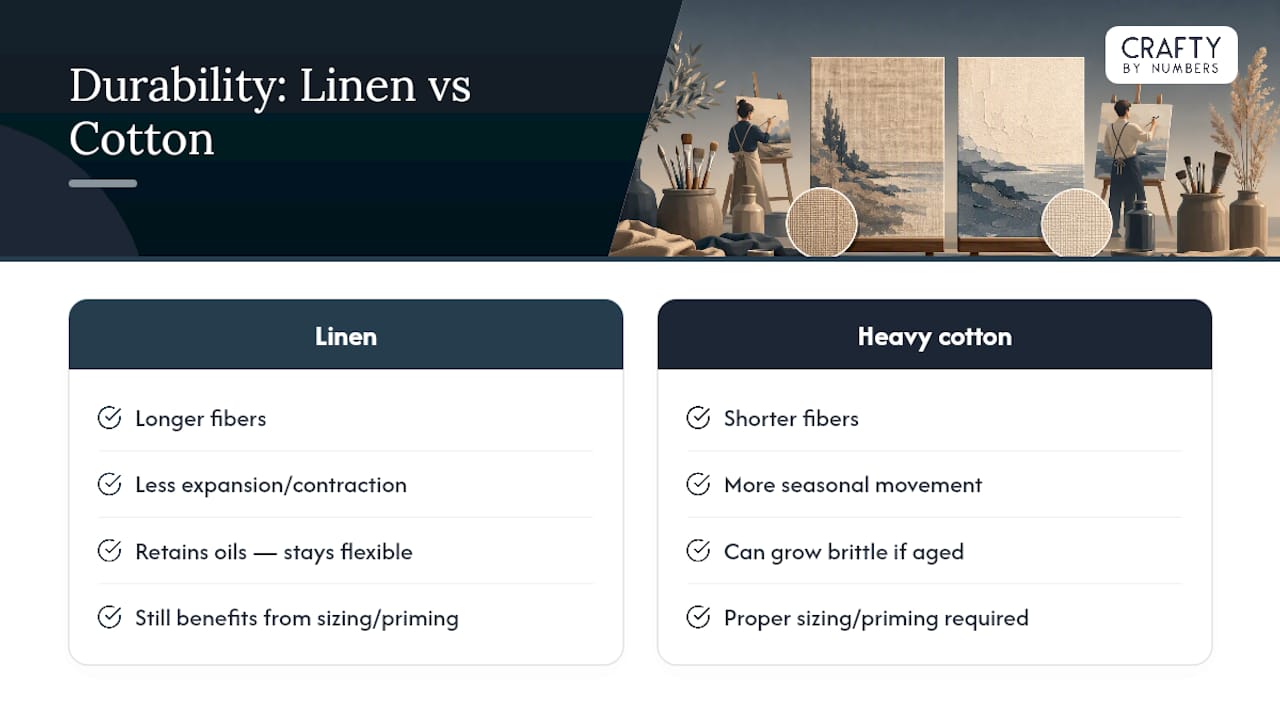
Linen’s fibers run longer than cotton’s, and that single structural fact is why conservators consistently rate linen higher for long-term stability. Longer fibers mean less expansion and contraction as humidity shifts, so a linen canvas holds its tension across seasons and climate swings far more reliably than cotton does.
Linen also retains natural oils within its fibers, a detail conservators point to as a reason it tends to stay flexible rather than growing brittle with age, unlike some aged cotton supports.
That said, don’t write off cotton for anything meant to last. A heavyweight cotton duck canvas, properly sized and primed, can hold up for generations, and fiber choice is just one variable among several that determine a painting’s lifespan, alongside the ground, the paint quality, and how the finished piece is stored. If you’re selling or exhibiting work, linen is the safer investment. If you’re building a personal collection on a budget, a well-prepared heavy cotton canvas won’t let you down.
Stretching and Priming: The Handling Differences That Trip People Up
This is where the two fabrics really diverge in practice. Cotton is elastic and forgiving. You can pull it taut over a stretcher bar by hand, and minor unevenness in your tension corrects itself once you prime the surface. Linen is a different animal entirely: it’s inelastic and genuinely difficult to stretch evenly, especially past 24 inches on a side, which is why most painters buy linen pre-stretched or hand it to a professional canvas stretcher.
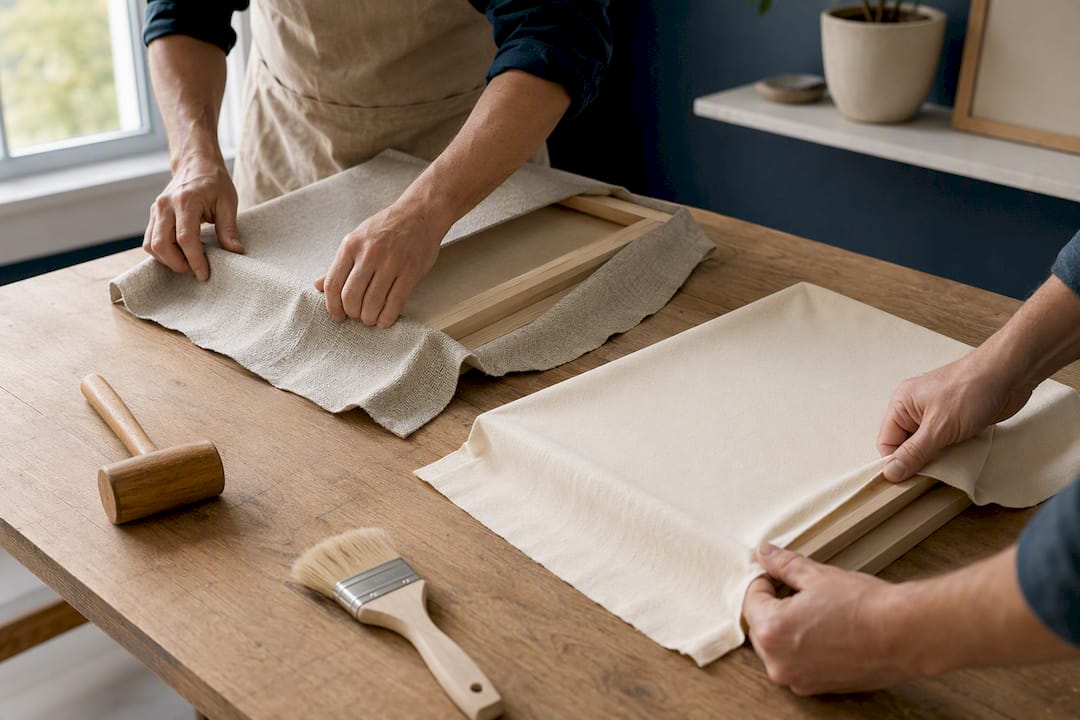
Priming adds another wrinkle for both fabrics: sizing and gesso cause the weave to contract, and on larger formats that contraction can twist or strain the stretcher bars if you don’t plan for it.
A simple sequence keeps you out of trouble:
- Staple or tack the center of each side first, working outward in opposing pairs.
- Pull evenly across the whole canvas rather than cranking one corner tight.
- Prime, let it dry fully, and check tension again since it will shift.
- Re-tighten stretcher key wedges once the ground has cured, especially on linen.
Pro Tip: If you’re stretching linen for the first time, prime it while it’s still on the stretcher bars, not before. Priming an unstretched piece of linen makes it noticeably harder to pull taut afterward.
Which Canvas Fits Your Project: A Use-Case Breakdown
The right fiber depends entirely on what you’re painting and why, not on which one sounds more serious.
- Portraits and fine detail: linen’s smoother weave gives you more control over subtle transitions; a very fine professional-grade cotton is a reasonable substitute if budget is tight.
- Large-scale or heavy-technique work: linen holds tension better across big spans, though a properly framed heavy cotton canvas can still perform well at scale.
- Practice, studies, and classes: professional cotton or a canvas panel makes far more sense than spending on linen for something you might paint over.
- Paint by numbers and guided kits: pre-primed cotton is the standard, and for good reason. It’s dimensionally stable, takes acrylic evenly, and doesn’t demand the stretching finesse linen requires.
Medium matters too. Oil painters tend to gravitate toward linen because its texture and stability suit slow-drying, layered work. Acrylic is more forgiving of either fabric once properly primed, which is one reason acrylic-based paint-by-numbers kits work well on cotton without any compromise in the final look.
Stretched Canvas vs Canvas Panels: When Each One Makes Sense
Canvas panels and stretched canvas solve different problems, and confusing them is a common beginner mistake. Panels are rigid boards with canvas glued flat across the surface. They stack flat for storage, survive being tossed in a bag for plein air work, and cost less per unit, which makes them ideal for high-volume practice.
Stretched canvas is the better choice once you’re painting something you intend to hang. The taut surface over a wooden frame gives you that responsive “bounce” under the brush, and it remains the standard for exhibition and large-scale work because it goes straight from easel to wall without needing a frame first.
- Panels: rigid, stackable, budget-friendly, best under roughly 16x20 inches.
- Stretched canvas: display-ready, better tension response, standard for anything you plan to hang or exhibit.
- If you finish a flat piece and want it wall-ready, turning a painted canvas into a stretched display is a straightforward next step rather than starting over on a new support.
Why Trust This Canvas Comparison
This guide comes from Craftybynumbers, where we’ve built kits for more than 120,000 customers who needed a canvas that behaves predictably from the first stroke to the last. Every kit ships with a pre-printed canvas, matched acrylic paints, and detail brushes, which means we’ve spent a lot of time thinking about exactly the questions this article answers: what surface holds paint evenly, what stretches without warping, and what a beginner can actually manage without a studio’s worth of tools.
Author Paula S. covers canvas texture and materials for Craftybynumbers, and that focus is exactly why pre-primed cotton shows up in most of our kits: it’s dimensionally stable, takes acrylic evenly, and skips the stretching headaches linen introduces for a first-time painter.
What Most Canvas Advice Gets Backward
Most comparisons treat this as a hierarchy: linen wins, cotton is the compromise. That framing misses the point. The real question isn’t which fiber is “better,” it’s which one matches what you’re actually trying to do this weekend.
Where the conventional advice really falls short is in ignoring handling. Plenty of hobbyists buy linen because they’ve read it’s superior, then spend an afternoon fighting an inelastic weave that won’t sit flat on a stretcher bar. That’s not a fiber problem. That’s a mismatch between the material and the skill level of the person using it.
If I had to prioritize one thing for someone starting out, it wouldn’t be fiber content at all. It would be surface stability. A well-primed, properly stretched cotton canvas will outperform a poorly handled piece of linen every time, regardless of what the label says. Save linen for the piece you already know you’re proud of. Learn the craft on cotton first.
— Paula S.
Get a Canvas That’s Already Primed and Ready to Paint
If everything above tells you cotton is the right call for practice and guided projects, you don’t have to source fabric, stretch it, or prime it yourself. Craftybynumbers builds every kit around a pre-primed cotton canvas so you can skip straight to painting, no stretching frustration, no priming guesswork, no wondering if your tension is even.

Kits like Ivory Essence and Garden of Dreams come with a pre-printed canvas, matched acrylics, and detail brushes for detailed floral and nature scenes. Blossoming Cottage and Gentle Sakura suit painters who want a finer, softer surface for delicate subject matter, while Crimson Cloak and Vivid Passion lean into bold, saturated palettes for anyone who wants their finished piece to make a statement on the wall. For a cozier, home-decor feel, Cozy Armchair and Spa Candles fit right into a living room or gift box.
Browse the full kit collection and pick the canvas and subject that fits your next project.
Sources
- What is the difference between cotton and linen canvases? – Winsor & Newton
- Choosing the Right Canvas for Your Painting - Jackson’s Art Blog
FAQ
What are the downsides of cotton canvas?
Cotton stretches less evenly over time under heavy paint layers and reacts more to humidity than linen, so it’s not the top choice for archival or exhibition-bound work, though a heavyweight, properly primed cotton canvas still performs well for most hobbyist and practice needs.
Is 100% cotton better than linen?
Not universally. Cotton is easier to stretch, cheaper, and perfectly capable for practice, studies, and kits like paint by numbers projects, while linen holds tension longer and resists humidity better, making it the stronger choice for pieces meant to last decades.
Why do artists paint on linen?
Artists choose linen for its finer weave, which suits detailed brushwork and glazing, and because its longer fibers and retained natural oils give it better long-term stability, a quality conservators consistently value in work intended for sale or exhibition.
What is the disadvantage of linen?
Linen is more expensive than cotton and is genuinely harder to stretch by hand, since its fibers lack cotton’s elasticity, which is why most painters buy linen pre-stretched rather than stretching it themselves.
Is cotton canvas good enough for paint by numbers kits?
Yes. Pre-primed cotton is dimensionally stable, takes acrylic paint evenly, and avoids the stretching difficulty linen introduces, which is exactly why it’s the standard canvas across most guided paint-by-numbers kits.
0 commentaire