

Custom paint-by-numbers suits minimalist interiors when you control four things: the subject, the palette, the scale, and the finish. Get those right and a personal piece reads as intentional art, not a craft project leaning against the wall.
Three reasons this works:
- Personal meaning without visual noise. A photo turned into a numbered canvas carries a story a generic print never could, without adding clutter if the image itself is simple.
- You control the palette and scale before you paint. Unlike buying a finished piece, you choose the size and colors to match your room from the start.
- Kit quality determines whether it looks finished or homemade. Pre-printed canvases and fade-resistant acrylics, the kind Craftybynumbers builds its kits around, are what separate “nice hobby” from “gallery piece.”
Key Takeaways
Custom paint-by-numbers works in minimalist rooms when the subject, palette, scale, and finish are all deliberately controlled rather than left to chance.
| Point | Details |
|---|---|
| Choose a quiet subject | Pick a single focal point with a plain background instead of a busy, detailed scene. |
| Match palette to the room | Select or edit colors so the finished piece echoes your existing neutral or accent tones. |
| Prioritize material quality | Look for cotton or linen canvas, fade-resistant acrylics, and fine-detail brushes. |
| Finish and frame with intent | Seal with matte or satin sealant and hang in a floating frame, not glass. |
| Hang at the right height | Center the piece at 57 to 60 inches, leaving 10 to 15 centimeters above furniture. |
| Craftybynumbers as the standard | Craftybynumbers kits include pre-printed canvases and matched paints built for display-ready results. |
Table of Contents
- Why Personalized Art Complements Minimalist Design
- How to Choose an Image That Reads Minimalist Once Converted
- Choosing Kit Quality So the Finished Piece Looks Gallery-Ready
- Framing, Placement, and Styling Rules for Minimalist Rooms
- What Most Advice Gets Wrong About Custom Art and Minimalism
- Why Craftybynumbers Custom Kits Fit a Minimalist Room
- Sources
- FAQ
Why Personalized Art Complements Minimalist Design
Minimalist design runs on three unspoken rules: simplicity of form, generous negative space, and a restrained color story. Most people assume that ruling out clutter means ruling out personality too. It doesn’t. A custom kit lets you keep the rules and still hang something that means something to you.
Simplicity comes from the source image, not from a limited emotional range. A single tree, one architectural line, a lone vase, these are minimalist subjects because they’re visually quiet, and they can still be pulled from your own photo library. Negative space works the same way: a custom canvas with one clear focal point and a plain background leaves the eye room to rest, exactly like a designer print would.
“A customised painting by numbers can bring a personal touch to your walls while still functioning as considered home décor,” according to FAD Magazine’s coverage of the trend.
The relaxation angle matters here too. Painting itself is the slow, repetitive kind of task that psychologists associate with lower stress, and a 2026 Bupa survey reported by Obviousmag found that most adults already recognize creative activities benefit mental health, even though many rarely make time for them. That same piece notes a meaningful share of adult kit buyers pick up paint-by-numbers specifically to make something for their home, not just to pass an evening. The meditative pull of the process is part of why the finished object feels earned rather than generic.
Pro Tip: Before you commit to a photo, ask whether it would still feel calm blown up to canvas size. Busy, high-contrast images fight a minimalist room; quiet ones settle into it.
How to Choose an Image That Reads Minimalist Once Converted
The photo you upload decides almost everything about how the finished canvas will look. A cluttered snapshot becomes a cluttered painting no matter how carefully you paint it.
- Start with a high-resolution photo. Blurry or low-res images lose detail in conversion and can produce oddly small, hard-to-paint sections once the kit is generated.
- Look for strong, even lighting. Harsh shadows or blown-out highlights translate into muddy color blocks; soft natural light gives cleaner lines.
- Pick one focal point, not three. A single subject, a chair, an archway, a cluster of vases, gives the composition the same quiet weight a minimalist print has.
- Crop out background noise before you upload. Remove stray objects, tighten the frame, and leave breathing room around the subject rather than filling the whole canvas edge to edge.
- Favor architectural lines, single objects, or neutral portraits. These subjects naturally match contrast and composition guidelines that kit makers recommend for a satisfying, clean result.
Pro Tip: If you’re unsure whether a photo will simplify well, convert it to black and white first. If the shapes still read clearly without color, the composition is strong enough for a minimalist canvas.
For inspiration on subjects that hold up at scale, browsing customization ideas before you upload saves a lot of trial and error later.
Choosing Kit Quality So the Finished Piece Looks Gallery-Ready
Two kits can start from the same photo and end up looking completely different, and the gap almost always comes down to materials.
Look for these before you buy:
- A cotton or linen canvas rather than thin, flexible fabric that warps once stretched.
- Fade-resistant acrylic paints with enough pigment density to cover in one or two coats.
- Fine-detail brushes for edges and small sections, not just one flat brush for everything.
- A high-resolution print conversion so lines stay crisp instead of pixelated.
Finishing decides the rest. A matte sealant reads calmer and more contemporary; satin adds a slight sheen that suits richer color palettes. Either way, sealing the finished canvas protects the paint and gives it a slightly more polished surface. Skip glass entirely if you can. Glass over a painted canvas creates glare and flattens the texture that makes it look hand-painted in the first place.
Craftybynumbers builds every kit around this exact standard: pre-printed canvases, matched acrylic paints, and detail brushes included as standard, not sold separately.
More than 120,000 customers have used Craftybynumbers kits, a scale that reflects how many people now treat paint-by-numbers as a decor decision rather than a rainy-day hobby, echoing the decor-driven motivation Obviousmag reports among adult buyers.
Framing, Placement, and Styling Rules for Minimalist Rooms
The frame and the wall do as much work as the painting itself. A heavy, ornate frame undoes a simple composition instantly.
- Choose a floating frame. It creates a thin shadow gap around the canvas edge, which reads as deliberate and modern rather than decorative.
- Skip carved wood, gold leaf, or anything textured. These fight the calm the rest of the room is working toward.
- Hang the center around 57 to 60 inches from the floor, the standard eye-level height styling guides recommend for most rooms.
- Leave 10 to 15 centimeters between the top of furniture and the bottom of the frame. Too much gap makes the piece look unrelated to the furniture below it; too little makes it feel cramped.
- Choose one large piece over a cluttered series when the wall is small. Minimalism rewards restraint, and a single confident piece usually outperforms three competing for the same space.
Pro Tip: If you’re torn between one large canvas and a grouped set, measure your negative space first. A wall with less than three feet of clearance around the furniture almost always looks better with a single piece.
Finishing Touches That Make DIY Art Read as Curated Design
A few small habits separate a hobby piece from something that looks professionally sourced.
- Keep the frame finish consistent across every piece in a room, mixing wood tones and metals undercuts the calm you’re building.
- Limit nearby accessories to one or two objects; let negative space do the work instead of filling every surface.
- Photograph the finished canvas in good light before hanging it, both for your own record and for sharing.
- Ask for a clean, professional stretch and even edges when finishing the canvas, and use uniform matting if you frame more than one piece.
What Most Advice Gets Wrong About Custom Art and Minimalism
Most guidance on minimalist decor treats personalization and restraint as opposites, telling readers to choose between meaningful and clean. That’s backwards. The actual tension isn’t personal versus minimal, it’s simple versus busy, and a custom photo can land on either side depending entirely on the choices made before a single stroke of paint goes down.
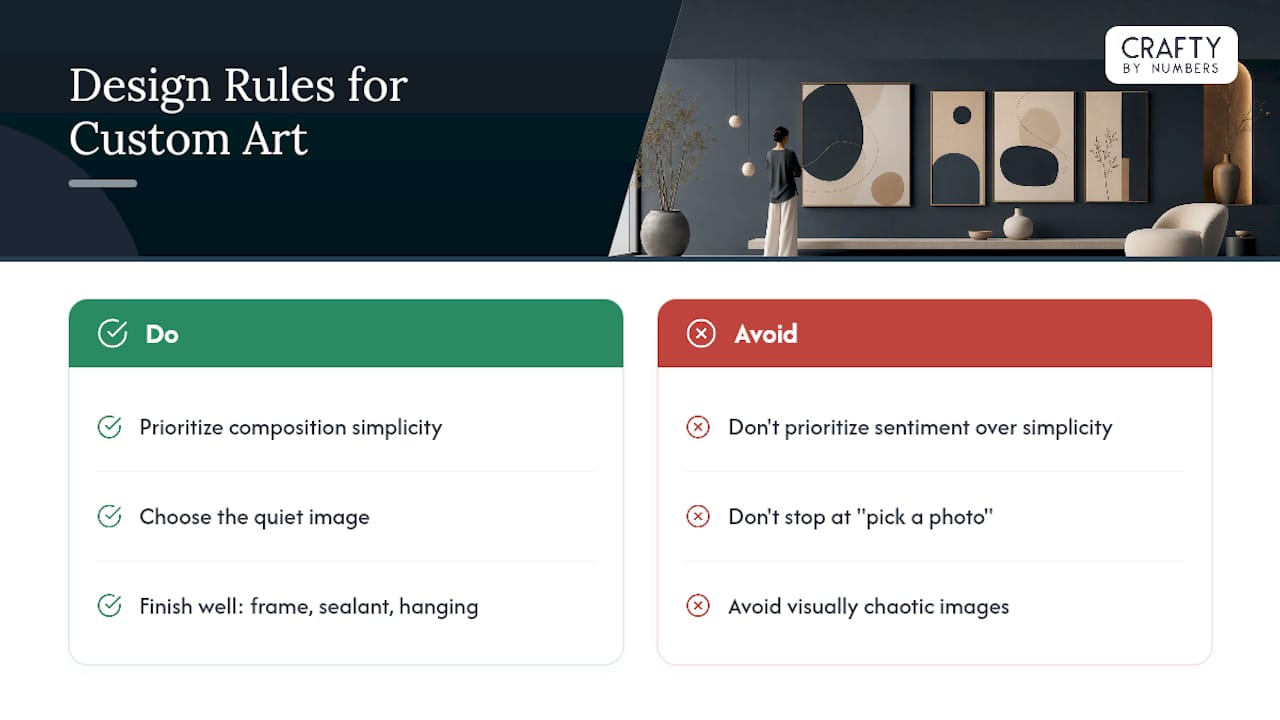
Where a lot of advice falls short is stopping at “pick a nice photo.” The photo matters, but the finishing decisions, sealant, frame, hanging height, do more to signal intentionality than the subject ever will. A stunning composition in a cheap frame under glare still looks like a kit. A modest composition finished well often doesn’t.
If you’re prioritizing anything first, prioritize composition simplicity over sentimentality. A photo that feels emotionally important but visually chaotic will fight your room no matter how well you paint it. Choose the quiet image, even if it wasn’t your first instinct.
Why Craftybynumbers Custom Kits Fit a Minimalist Room
Every rule covered above, simple subjects, restrained palettes, display-ready materials, floating frames, is exactly what Craftybynumbers builds into its kits from the start. Each order ships with a pre-printed canvas, matched acrylic paints, and detail brushes, so the material quality that makes a piece look finished rather than homemade is handled before you open the box.
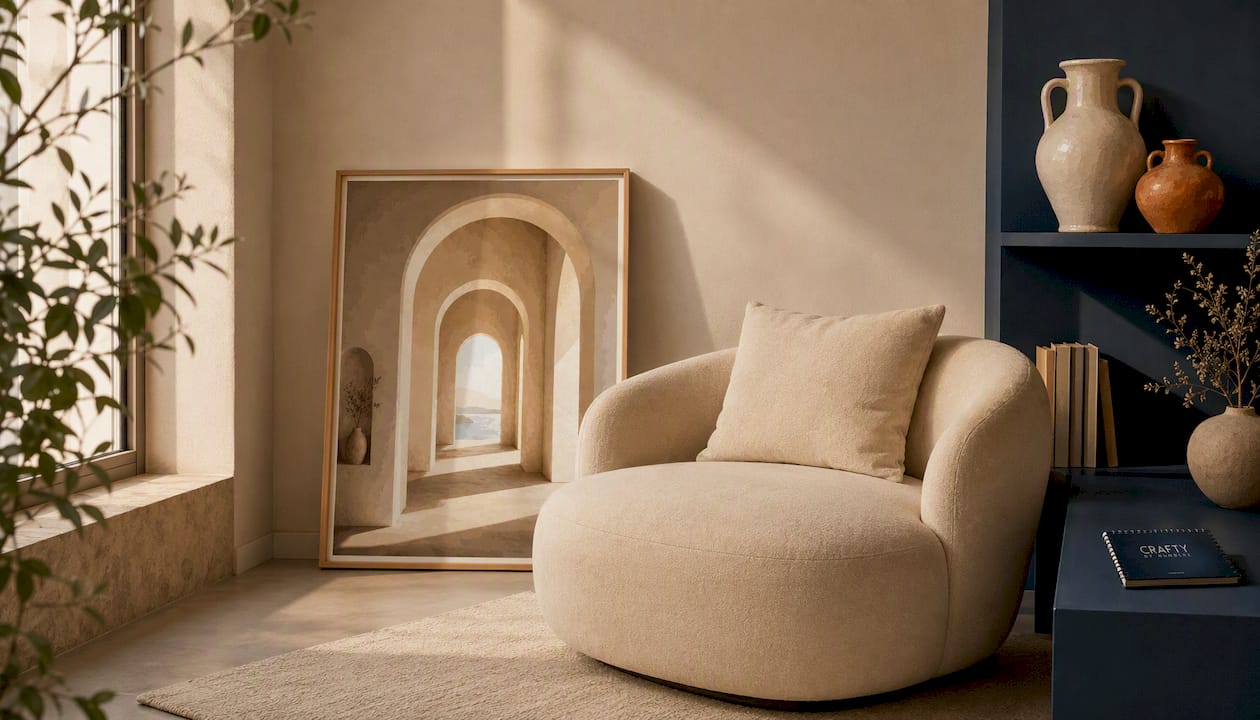
Three kits show how this plays out in real rooms. The Cozy Armchair kit is best for a neutral living room corner that needs warmth without pattern, its standout is a soft, muted palette that sits quietly against cream or slate walls. The Archway View kit is best for modern spaces with clean architectural lines already in the room, and its standout is the strong single sightline that mirrors minimalist composition rules almost exactly. The Clay Vases kit is best for a still-life lover who wants sculptural interest without color noise, standing out for its neutral tones that pair with almost any existing decor.
If you already have a photo in mind, a custom kit built from your own image gets you the same display-ready result. Start by browsing the custom kit options and picking the canvas size that fits your wall.
Sources
- How Custom Paint by Numbers Kits Can Add a Personal Touch to Your Home Decor
- How Can a Customised Painting by Numbers Bring a Personal Touch to Your Walls? Explore Unique Home Décor Ideas - FAD Magazine
- Paint by Numbers: A Creative Escape that Doubles as Wall Art - Obviousmag
- How to Elevate Your Home with Custom Paint-by-Numbers
FAQ
Does custom paint-by-numbers actually look minimalist when finished?
It can, but only if the source photo has a single focal point and a restrained color range; busy or high-contrast images resist a minimalist look no matter how the piece is framed.
What frame works best for a minimalist room?
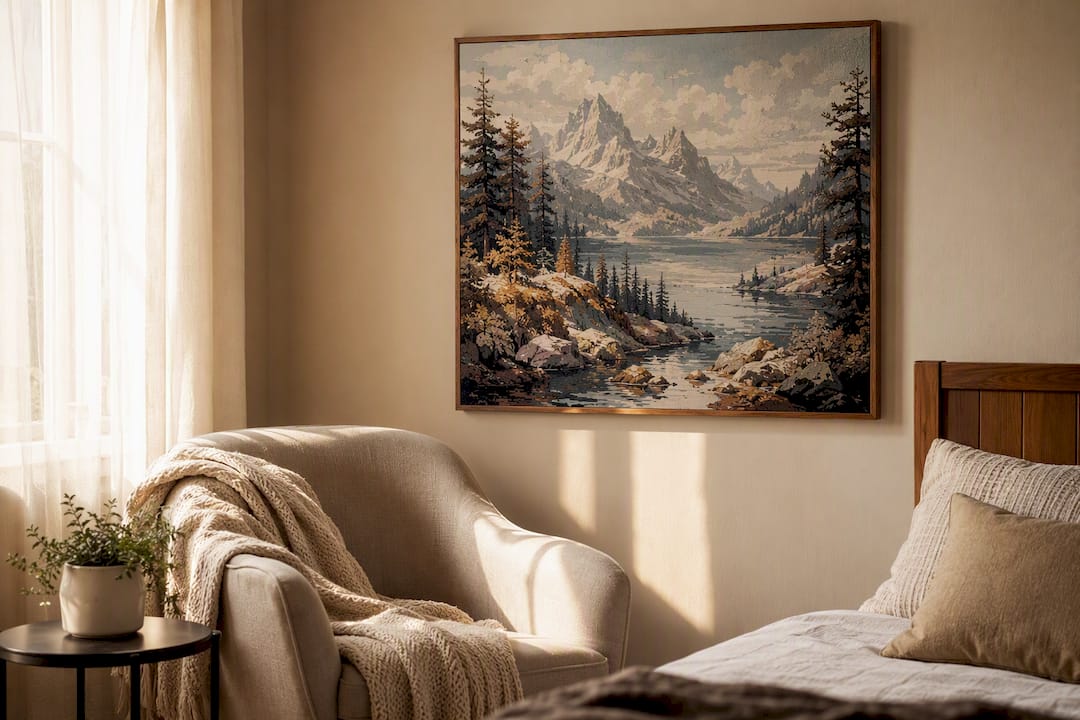
A floating frame is generally the better choice since it adds a clean shadow gap without the visual weight of an ornate or heavily textured frame.
How high should I hang custom art above a sofa or console?
Center the artwork around 57 to 60 inches from the floor, and leave about 10 to 15 centimeters between the furniture top and the frame’s bottom edge.
Does Craftybynumbers offer kits suited to minimalist decor?
Yes. Kits like Cozy Armchair, Archway View, and Clay Vases use simple compositions and neutral palettes designed to sit comfortably in minimalist rooms.
Should I seal a finished paint-by-numbers canvas?
A clear acrylic sealant in matte or satin protects the paint and gives the surface a slightly more polished, gallery-like finish.
0 commentaire