

Large canvas paintings are defined as works measuring 40x60 inches or larger that serve as the dominant visual anchor in a room. They do not merely decorate a wall. They organize the entire space around themselves, directing the eye, shaping the mood, and setting the design hierarchy before a single piece of furniture is chosen. Understanding why large canvas paintings stand out requires looking at both design science and environmental psychology. The impact of large canvas art goes far beyond aesthetics. It reaches into how you feel, think, and move through a room.
Why large canvas paintings stand out in room perception
Scale is the first thing a room communicates. A large canvas painting covering 40–60% of a wall acts as a primary visual anchor, reducing visual noise and sharpening spatial perception. That coverage threshold is not arbitrary. Design industry standards define it as the minimum needed for a painting to read as an intentional design element rather than a decorative accessory.
Oversized canvases also reshape how you perceive the room’s dimensions. Large art makes ceilings appear taller and walls wider by serving as a strong vertical and horizontal visual cue. A single large painting in a modest living room can make the space feel significantly more open without any structural change.
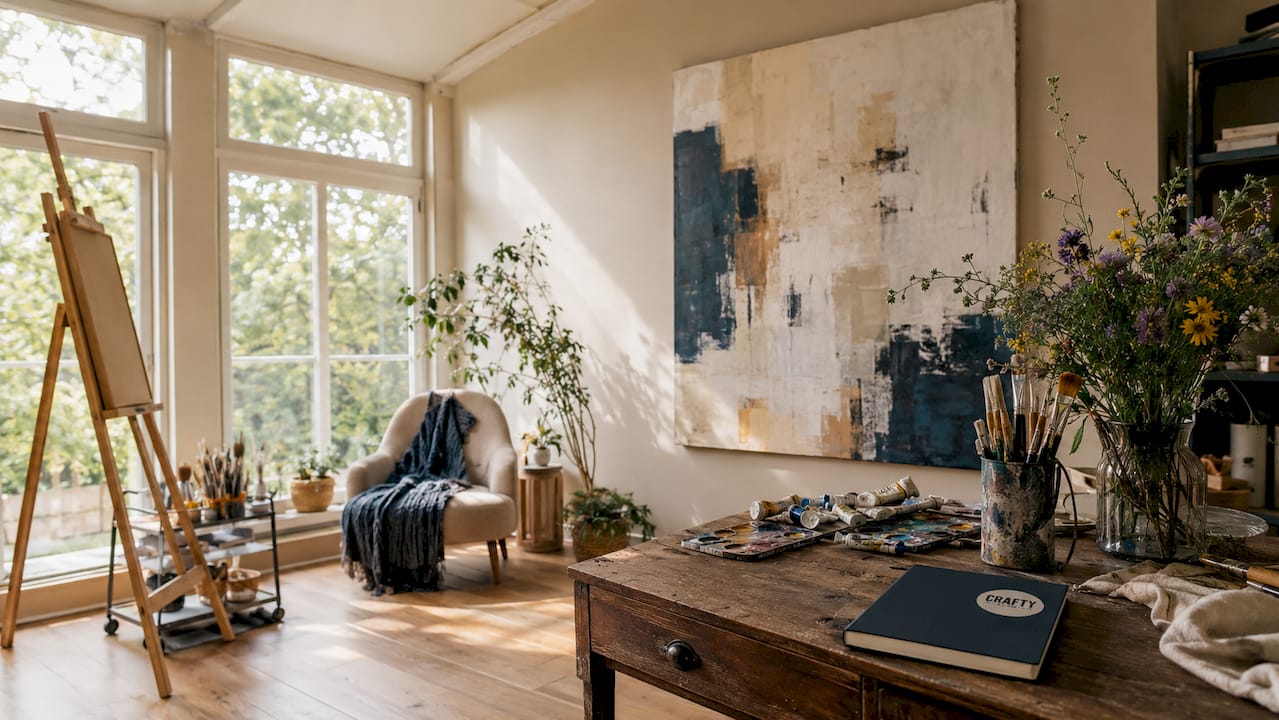
Scale must relate to the room’s volume and furniture to avoid imbalance. A canvas that is too small for the wall reads as an afterthought. Correct scale matching allows artwork to become a foundational structural element rather than a decorative detail. This is why professional designers treat large canvases the same way they treat architectural features like windows or fireplaces.
Key factors that determine whether a large canvas succeeds in a space:
- Wall coverage: Aim for 40–60% of the wall’s width for the painting to anchor the room.
- Furniture relationship: The canvas width should be roughly 75% of the furniture piece below it.
- Ceiling height: Taller ceilings support taller canvases; low ceilings benefit from wide horizontal formats.
- Color continuity: The painting’s palette should echo at least one color already present in the room.
Pro Tip: Before buying, cut craft paper to the painting’s exact dimensions and tape it to the wall. Live with it for a day. You will immediately see whether the scale works.
How does large canvas art affect your mental wellbeing?
Large wall art provides measurable mental health benefits by lowering cognitive load and improving creativity and emotional safety. The mechanism is straightforward. When your eyes land on a single, strong focal point, they stop scanning. That reduction in scanning reduces vigilance, which lowers stress.
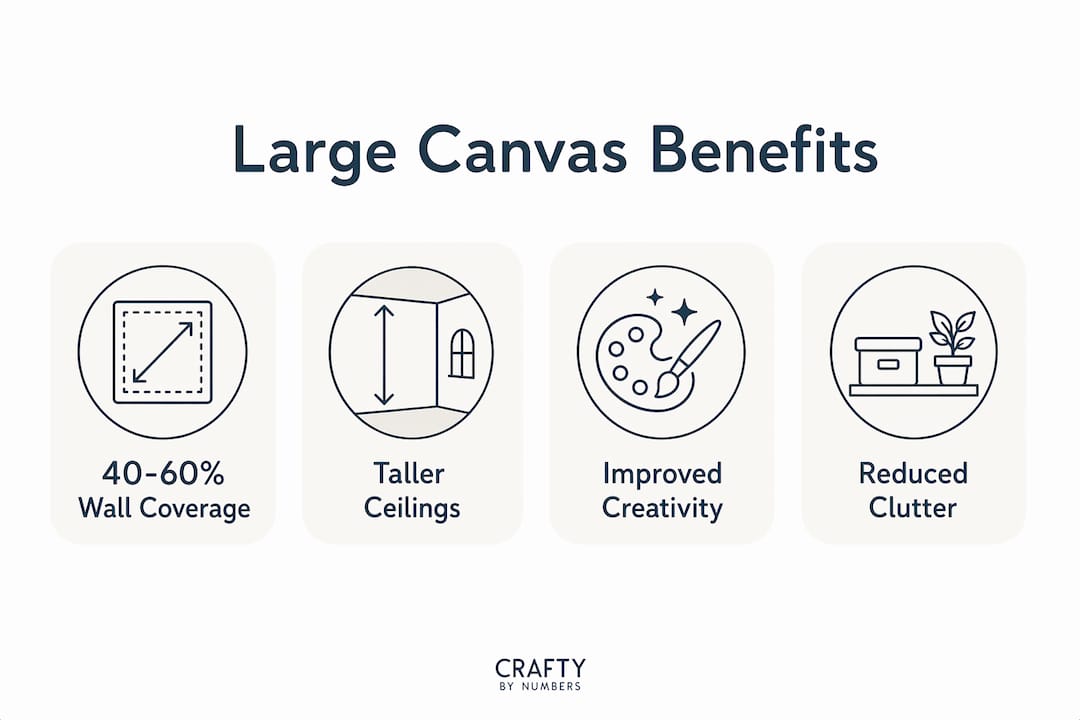
A room full of small prints, mismatched frames, and scattered objects forces your brain to process many competing signals at once. A single large canvas eliminates that competition. It gives your nervous system a place to rest.
Environmental psychology research confirms this effect. Large visual anchors correlate with greater emotional comfort in interior spaces. The physical scale of the artwork crosses a psychological threshold that smaller pieces simply cannot reach. Once art reaches sufficient scale, it stops being something you look at and becomes something you feel.
“A psychological threshold is crossed when art reaches scale sufficient to reduce environmental vigilance and increase emotional comfort. Scale is not just a design preference. It is a psychological tool that shapes how safe and settled we feel in a room.”
The benefits of big paintings in a home environment include:
- Reduced visual clutter: One strong focal point replaces the noise of many small pieces.
- Improved creativity: Exposure to large, stimulating artwork has been linked to broader associative thinking.
- Emotional grounding: Scale creates a sense of permanence and stability in a room.
- Stress reduction: Fewer competing visual signals mean a quieter, more restful environment.
Craftybynumbers has built its entire product philosophy around this principle. Art should feel good to live with, not just look good in a photo. The stress relief benefits of art are well documented, and large canvases amplify those benefits by making the artwork impossible to ignore.
Large canvas vs. gallery wall: which is the better choice?
One large canvas installation requires less time and effort than a gallery wall and achieves a better cost-per-impact ratio. A gallery wall demands planning, multiple mounts, precise leveling, and consistent spacing. One large canvas installs in about 10 minutes with a single mounting point. That simplicity is not just convenient. It eliminates the most common decorating mistakes.
| Feature | One large canvas | Gallery wall |
|---|---|---|
| Installation time | About 10 minutes | Several hours |
| Mounting points | One | Multiple |
| Risk of spacing errors | Very low | High |
| Visual clarity | Strong single focal point | Fragmented attention |
| Cost per visual impact | High | Lower |
| Design flexibility | Easy to reposition | Difficult to change |
Gallery walls work well in specific contexts, like hallways or stairwells where a narrative sequence of images makes sense. For living rooms, bedrooms, and dining spaces, a single large canvas almost always delivers more visual authority and emotional coherence.
Investment in one large piece avoids the framing, layout, and leveling issues that plague gallery walls. The cost of five small framed prints, including frames and hardware, often matches or exceeds the cost of one large canvas. The large canvas wins on every practical measure.
Pro Tip: If you love the idea of a gallery wall but keep second-guessing the layout, that hesitation is a signal. A large canvas removes the decision fatigue entirely.
What makes canvas paintings unique in material quality?
The material qualities of a canvas painting are what separate it from a printed poster or a digital reproduction. Layered glazed oil paintings on canvas interact dynamically with light, adding optical depth that flat ink prints cannot replicate. As light shifts throughout the day, the painting changes with it. That living quality is what makes large canvas art feel permanent and valuable.
The artistic techniques that give large canvas paintings their presence include:
- Layered glazing: Thin, transparent layers of paint build optical depth. Light passes through each layer and reflects back differently, creating a luminous effect that grows richer at larger scales.
- Impasto texture: Thick paint application creates physical ridges that cast micro-shadows. At large scale, this texture becomes visible from across the room.
- Canvas weave interaction: The texture of the canvas itself contributes to the painting’s surface. This tactile richness is completely absent in printed reproductions.
- Color mixing on the surface: Hand-painted works carry the evidence of the artist’s decisions. Blended edges, varied brushwork, and tonal shifts give the painting a visual complexity that printed art cannot match.
These qualities matter more at large scale than at small scale. A 12x16 inch print and a 12x16 inch oil painting look similar from a distance. A 40x60 inch oil painting and a 40x60 inch print look completely different. The canvas texture, the paint depth, and the light interaction all become major visual features at that size. Artists who want to submit large-scale work for exhibition or publication will find that these material qualities are what curators and editors notice first.
Key Takeaways
Large canvas paintings stand out because they serve as visual anchors that organize space, reduce cognitive load, and create emotional comfort through scale.
| Point | Details |
|---|---|
| Optimal wall coverage | Aim for 40–60% wall coverage so the painting reads as an anchor, not an accessory. |
| Psychological impact | Large art reduces visual scanning, lowers stress, and increases emotional comfort in a room. |
| Installation advantage | One large canvas installs in about 10 minutes with a single mount, avoiding gallery wall errors. |
| Material depth | Hand-painted canvas textures and glazing techniques create visual richness that prints cannot replicate. |
| Design hierarchy | Large canvases act as architectural elements, organizing furniture and color palettes around them. |
Why I think most decorators are thinking about scale all wrong
Paula S. here. After years of working with art in interior spaces, the single most common mistake I see is undersizing. Decorators and homeowners choose a painting they love, then buy it in a size that feels “safe.” The result is a beautiful piece of art that the room completely ignores.
The fear of going too big is almost always unfounded. Undersized art causes visual clutter because it competes with everything else on the wall without winning. A large canvas does not compete. It settles the room. Everything else organizes around it, and the space suddenly feels intentional.
What I find most interesting is how large canvases function as architectural organizing devices. Professional designers know this. They choose the art first and build the room around it. That is the opposite of what most homeowners do, and it explains why professionally designed rooms feel so cohesive. The art is not the finishing touch. It is the starting point.
My honest advice: measure your wall, calculate 40–60% of its width, and buy a canvas that fills that space. You will not regret it. The room will thank you.
— Paula S.
Craftybynumbers canvases that anchor a room
Craftybynumbers offers large canvas painting kits designed to produce display-quality results, even for first-time painters. Each kit includes a pre-printed canvas, high-quality acrylic paints, and detail brushes. The finished pieces are vibrant enough to serve as genuine room anchors.

For a painting with quiet elegance, Ivory Essence delivers a refined palette that works in living rooms and bedrooms. For something bolder, Garden of Dreams brings rich color and movement to any wall. If you want to display your finished canvas properly, Craftybynumbers also provides guidance on stretching and mounting. With over 120,000 satisfied customers, Craftybynumbers turns the process of creating large canvas art into something relaxing, rewarding, and worth hanging.
FAQ
What size painting is considered large for a wall?
Design industry standards define large canvases as 40x60 inches or above. A painting covering 40–60% of a wall’s width reads as a primary visual anchor rather than a decorative accessory.
Does large wall art make a small room look bigger?
Large art makes ceilings appear taller and walls wider by drawing the eye vertically and horizontally. This spatial illusion works in small rooms as effectively as in large ones.
Why does oversized art attract more attention than smaller pieces?
Oversized art creates a single, dominant focal point that the eye moves toward automatically. Smaller pieces compete with surrounding objects, while a large canvas resolves that competition immediately.
Is one large canvas better than a gallery wall?
One large canvas installs faster, requires a single mounting point, and delivers stronger visual clarity than a gallery wall. Gallery walls work well in hallways and stairwells but rarely match the impact of a single large piece in a main living space.
How does large canvas art affect stress levels?
Large art reduces the need for eye scanning across multiple visual points, which lowers environmental vigilance and stress. Environmental psychology research links large visual anchors to greater emotional comfort and a more settled feeling in a room.
0 comments