

Before you click “place order” on any personalized item: triple-check every name, initial, and date, then confirm your production timeline leaves room for a delay. Most disappointing custom gifts trace back to one of three checks skipped in the first five minutes of ordering.
- Spelling and accents — read the name field backward, then forward, then ask someone else to read it.
- Date format — UK sellers sometimes default to DD/MM/YYYY while US-based print shops use MM/DD/YYYY, so confirm which one your form uses.
- Photo quality — if you’re uploading an image, zoom to 200% on your phone; blur that’s invisible at thumbnail size becomes obvious on canvas.
The full checklist below covers proofs, lead times, materials, and budgeting.
Key Takeaways
Proofing personalization details before production, not sentiment or price, is the single biggest factor separating a gift that lands from one that disappoints.
| Point | Details |
|---|---|
| Proof everything twice | Check spelling, dates, and font size on a larger screen before approving any personalization. |
| Build in production buffer | Order 2 to 3 weeks ahead for birthdays and 4 to 6 weeks ahead of major holidays. |
| Confirm return policy first | Ask what qualifies for a remake before you pay, since approved proofs are rarely refundable. |
| Match personalization to the person | Save photo-based or date-based personalization for close relationships; keep monograms for lighter ties. |
| Consider Crafty By Numbers | A Gift Card or custom photo kit avoids exact-placement engraving risk while letting the recipient choose the final design. |
Table of Contents
- Common Mistakes Buying Personalized Gifts and How to Fix Them
- How a Reputable Seller Reduces Your Risk
- Matching the Gift to the Person, Not the Occasion
- Character Limits and Font Size Matter More Than You Think
- Get the Delivery Address Right, Not Just the Design
- Setting a Realistic Budget for Personalization
- Care Instructions Are Part of the Gift
- The Checklist Beats the Instinct
- A Lower-Risk Way to Give a Personalized Gift
- Sources
- FAQ
Common Mistakes Buying Personalized Gifts and How to Fix Them
Personalized gifts fail for predictable reasons, and most of them are catchable in under ten minutes if you know where to look. More than 40% of personalized gift orders contain avoidable mistakes like spelling errors, wrong dates, or design placement issues, and many of them trace back to skipping a proof check or ordering too close to a deadline.
-
Spelling and formatting errors. Names with unusual spellings, hyphens, or accents (think “Zoë” or “Siân”) get flattened by autocorrect or dropped entirely by basic order forms. Read the entire order aloud, out loud, before submitting. A second set of eyes catches what your own brain autocorrects without telling you.
-
Underestimating production time. Personalized items need extra days for design approval, cutting or printing, and hand-finishing that off-the-shelf products skip entirely. Order early enough ahead of birthdays, and allow additional time around major holidays when production queues back up. Failing to build in that buffer is one of the most common reasons custom orders miss their delivery window entirely.
-
Skipping or rushing the digital proof. A proof is your last chance to catch an error before it’s permanent. Check placement (is the text centered where you expect?), font size (readable at actual size, not just zoomed in), color contrast against the background material, and image resolution. Open the proof on a laptop or tablet rather than your phone; small screens hide alignment problems. Save a screenshot of your approval. Sellers commonly cannot accept returns once you’ve approved a proof, even if you spot something later, so that screenshot is your record of exactly what you signed off on.
-
Not checking return and remake policies before you buy. Ask directly: does a seller error (wrong name, misprint) qualify for a free remake? Does a buyer-approved proof with a typo you missed get any grace at all? Get this in writing before you pay, not after something arrives wrong.
-
Mismatching material to personalization method. Engraving suits metal and glass but chips on thin plastics. Heat-transfer print works for fabric but can crack on flexible items after repeated washing. Direct print holds fine detail and color better than engraving for anything photo-based. Ask which method the seller actually uses; “personalized” alone tells you nothing about durability.
-
Uploading low-quality photos. Blurry, dark, or low-resolution images consistently produce disappointing results once they’re enlarged onto a physical product. Use natural daylight, keep the subject in sharp focus, crop out busy backgrounds, and upload the highest resolution file your phone will export, not a compressed version from a group chat.
-
Over-personalizing. More text and more design elements do not equal more thoughtful. Editing your message down is one of the most consistently repeated pieces of expert advice for personalized holiday gifts, and shorter messages also carry less risk of a typo slipping through.
-
Vague instructions to the seller. “Make it look nice” gives a designer nothing to work with. Sellers who receive a clear brief, including the story behind the gift, consistently produce better results than those working from a blank request.
-
Bulk order mix-ups. Ordering five personalized mugs for a team? Double-check that each name is assigned to the correct recipient in the order form, and preview every single variant, not just the first one.
Pro Tip: Before you approve anything, screenshot the proof and text it to the person who knows the recipient’s name best. A second opinion from someone outside your own head catches errors your brain has already stopped seeing.
How a Reputable Seller Reduces Your Risk
The easiest way to avoid most of the mistakes above is to buy from a seller whose process already builds in checks you’d otherwise have to do yourself. Every Crafty By Numbers kit ships with a numbered canvas, matched acrylic paints, and detail brushes chosen specifically for the design’s level of detail, so the personalization decision happens once, at the photo stage, rather than at multiple fragile production steps.
- Digital proofs before production starts, so you see the exact canvas layout before it’s printed.
- A clear remake policy for errors that happen on the seller’s end.
- Visible quality checks on color accuracy and paint matching before a kit ships.
A custom paint-by-numbers kit sidesteps one of the riskiest parts of personalization: exact typeface or engraving placement. Converting a photo into a numbered canvas is inherently more forgiving than engraving a name onto glass, where a single misplaced character means starting over.
Crafty By Numbers has built this process around more than 120,000 completed orders, according to editorial lead Paula S., who notes that the production process behind custom art kits is designed specifically to catch photo and layout issues before a single drop of paint gets matched.
Matching the Gift to the Person, Not the Occasion
The biggest misconception in personalized gifting is that more customization automatically means more thoughtfulness. It doesn’t. A monogrammed item works well for a coworker or acquaintance precisely because it’s understated. A close family member or partner usually warrants something with more emotional weight, like a photo, a shared date, or coordinates from a meaningful location, tailored to their preferences.
Ask yourself what this specific person would actually display or use. Someone who keeps a minimalist home is unlikely to want a busy, text-heavy design cluttering their shelf. Someone sentimental about a specific memory will get more value from a single photo turned into art than from a generic “Best Mom Ever” mug. Matching personalization type to the relationship and the recipient’s actual style matters more than how much customization you cram in.
This is also where less-obvious personalization tends to age better. A monogram or a subtle date stays relevant for years. An overly specific inside joke printed prominently on an item can feel dated or even a little awkward two years later, once the context fades. When in doubt, choose the option that says something true about the relationship rather than something that just fills space on the product.
Character Limits and Font Size Matter More Than You Think
Every personalization field has a character limit for a reason, and that reason is almost always readability, not just database constraints. A name that fits neatly in a text box on your screen can wrap awkwardly, shrink to an illegible size, or get cut off once it’s actually printed on a smaller physical surface.
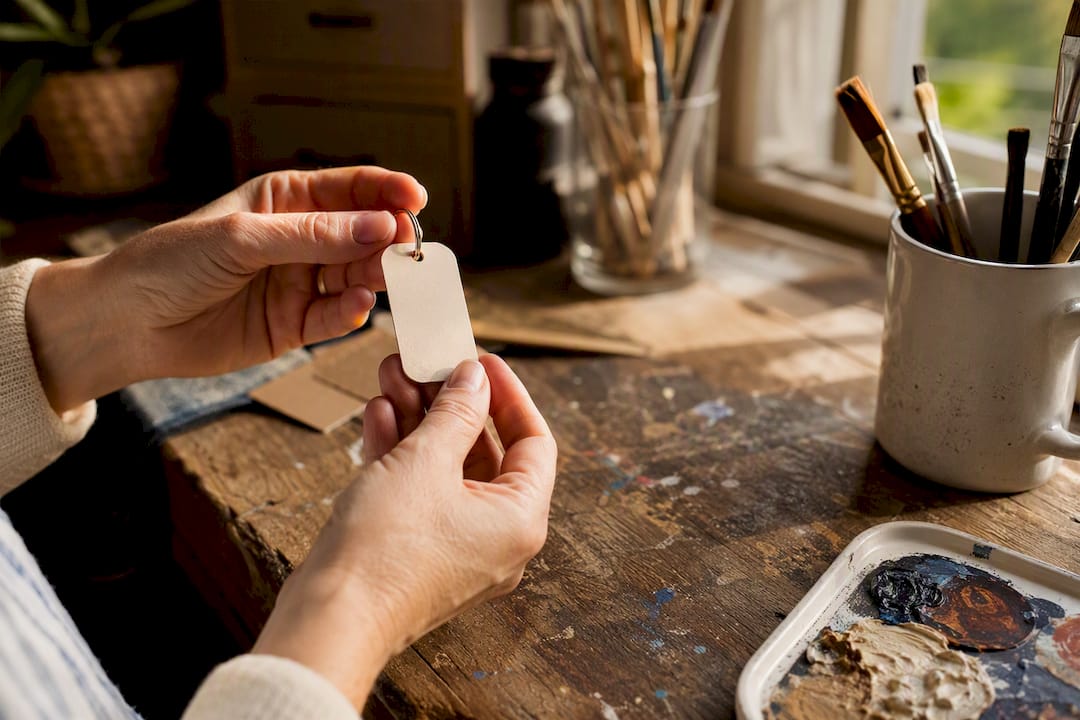
Before you type your message, check the seller’s stated character limit and respect it, even if the form technically lets you go over. If a product listing shows a preview image, zoom in on the font at actual size rather than trusting how it looks in the enlarged listing photo. Script fonts look elegant in a header image but can become unreadable at small sizes, particularly with longer names or when text needs to wrap onto two lines.
If you’re personalizing something small, like a keyring or a pendant, ask specifically what font size the seller uses for that product. A “16pt” font on a coffee mug reads completely differently than “16pt” on a 2-inch tag. When a proof is available, this is exactly the moment to check it: is the text legible at arm’s length, not just under a magnifying glass? If it’s borderline, ask for a size increase or a shorter message rather than hoping it’ll be fine in person.
Get the Delivery Address Right, Not Just the Design
A perfect personalized gift sent to the wrong address is still a failed order, and address mistakes are entirely preventable. Before you check out, confirm the recipient’s current address rather than relying on memory, especially for people who’ve moved recently or for gifts being shipped directly to someone other than yourself.
Double-check flat or apartment numbers, postcodes, and the spelling of the street name. A single transposed digit in a postcode can send a personalized item to a completely different building, and because the item is custom-made, it’s far less likely a seller will simply reprint and reship for free if the address error was on your end.
If you’re shipping directly to the recipient as a surprise, confirm the address with a mutual friend or family member rather than asking the recipient outright, which would spoil the surprise. And if the gift is time-sensitive, like a birthday, choose a delivery service with tracking so you know it arrived, rather than assuming silence means success.
Setting a Realistic Budget for Personalization
Personalization almost always adds cost on top of a base product price, and that markup varies more than most buyers expect. Simple text engraving might add a few pounds to a base item, while photo-to-product conversion, multi-color printing, or hand-finished detailing can add considerably more, depending on the complexity of the design and the material involved.
Set your budget around the base product first, then treat personalization as a separate line item you’re deciding on deliberately, not an afterthought that creeps up at checkout. Rush production, when a seller offers it, typically carries its own surcharge on top of the personalization fee, so factor that in if you’re ordering close to a deadline.
It’s also worth comparing what you’re actually paying for. A seller charging more for personalization but including a proof stage, a remake guarantee, and quality materials is often a better value than a cheaper option with no safety net if something goes wrong. The lowest listed price isn’t the lowest total cost if you end up paying twice because the first attempt arrived with an error.
Care Instructions Are Part of the Gift
A personalized item that fades, cracks, or peels within a year isn’t much of a keepsake, so durability deserves the same attention as the design itself. Different personalization methods age differently: engraved metal and glass hold up for decades with basic care, while heat-transfer prints on fabric or mugs can fade faster with dishwasher use or frequent washing.

Ask the seller directly what care the item needs before you buy, not after. A hand-painted or acrylic-finished piece, for instance, generally needs to avoid direct sunlight and excessive moisture to keep its color true over time. If the gift is something the recipient will use daily, like a mug or a tote bag, factor washing frequency into your material choice from the start rather than treating it as a minor detail.
Sellers who provide clear care instructions alongside the product are usually the same ones who’ve thought through the durability question at the design stage, not just the personalization stage. That’s a reasonable signal that the underlying materials were chosen for longevity, not just for how they photograph on a product listing.
The Checklist Beats the Instinct
Most guides on personalized gifts lean heavily on sentiment: pick something meaningful, something from the heart. That advice isn’t wrong, but it’s incomplete, and it quietly ignores the part where a beautiful idea gets ruined by a misspelled name or a missed delivery window. The emotional part of gift-giving rarely fails. The logistical part fails constantly, and it’s the part almost nobody checks twice.
What the evidence actually supports is a shift in priority: proof-check first, sentiment second. A thoughtful gift concept executed with a typo is worse than a simpler concept executed perfectly, because the error becomes the story instead of the gesture. I’d argue the conventional wisdom oversells “make it personal” and undersells “make it correct.”
If you take one thing from this checklist, take this: spend your first five minutes on the boring stuff, spelling, dates, proof approval, before you spend any more time deciding how personal the gift should feel. The sentiment survives a simple design. It rarely survives an error.
— Paula S.
A Lower-Risk Way to Give a Personalized Gift
If you’d rather sidestep the proofing, spelling, and character-limit risks entirely, a Crafty By Numbers Gift Card hands the final decision to the person who knows their own taste best, no engraved name to misspell, no font size to squint at. For gifts where you do want your own photo turned into art, Crafty By Numbers’ custom kits run through a photo-to-canvas conversion process rather than exact-placement engraving, which is exactly the lower-risk personalization route this checklist has been building toward.
Every kit ships with matched acrylic paints, detail brushes, and a proofed canvas layout, backed by a customer base of more than 120,000 orders and a straightforward remake policy if something on the seller’s end goes wrong. That combination of recipient choice and built-in quality checks is why it consistently ranks among the safest personalized gift options for anyone who’s been burned by a typo before.
Ready to skip the guesswork? Browse the Gift Card options and let the recipient pick the design that actually fits their space.
Sources
- Avoiding Common Mistakes When Ordering Personalized Gifts - Engraved Products
- 7 common mistakes when ordering custom gifts | Who’s M
- How to choose personalized holiday gifts that feel thoughtful for any budget | Prism News
FAQ
What Is the 5 Gift Rule?
The 5 gift rule is a gift-giving framework where each person receives five categories of items, commonly something they want, something they need, something to wear, something to read, and something to do, used mainly to simplify decision-making and control spending.
What Is the 7 Gift Rule?
Definitions vary, but the 7 gift rule generally extends the same idea to seven categories, adding things like an experience or a personalized keepsake to the standard want/need/wear/read/do structure.
What Are Common Mistakes to Avoid When Choosing a Personalized Gift?
The most frequent issues are spelling and date errors, skipping the digital proof stage, underestimating production time, and over-personalizing a message that would land better if kept short and specific to the recipient’s relationship.
What Gifts Should Not Be Gifted?
Items requiring exact sizing without prior confirmation, anything with a permanent personal detail you haven’t proofed, and highly personal items for casual relationships (a photo gift for a new coworker, for instance) tend to miss the mark or create an awkward mismatch in familiarity.
Is a Gift Card a Good Personalized Gift Option?
Yes. A Gift Card removes the risk of spelling errors, sizing mistakes, and style mismatches entirely by letting the recipient choose their own design.
0 Kommentare