

Framing finished canvas art means adding an external frame — a floater, box, or traditional style — around a stretched or painted-edge canvas to create a visual boundary, protect the surface, and tie the piece to your room’s decor. It is not required. Gallery-wrapped canvases with fully painted sides can hang directly on the wall for a clean, modern look. But a frame changes the experience of the piece, and for many paint-by-numbers hobbyists, it is the step that makes the work feel truly finished.
A few quick reference points before diving in:
- Gallery wrap / unframed: works when all four sides are painted; no frame needed.
- Float frame: leaves a 1/8–1/4 inch gap around the canvas edge so the full image stays visible.
- Offset clips: small metal hardware that secures the stretcher bars to the frame without touching the painted face.
- Craftybynumbers kits come on pre-printed stretched canvases that are compatible with all three framing approaches above.
Table of Contents
- Why should you frame a finished canvas at all?
- What frame styles work best for canvas art?
- How do you measure your canvas for a frame?
- What hardware actually holds the canvas in the frame?
- DIY framing vs professional framing: which makes sense?
- How do you hang and care for a framed canvas?
- Craftybynumbers’ recommendations for paint-by-numbers hobbyists
- Key Takeaways
- The frame is where the painting becomes the art
- Ready to frame your paint-by-numbers canvas?
- Useful sources
- FAQ
Why should you frame a finished canvas at all?
Framing a finished canvas does three things at once: it protects the edges and corners from bumps, it adds a dust barrier at the back, and it visually anchors the piece to the wall. According to Blick Art Materials, framing is a stylistic choice rather than a necessity for gallery-wrapped canvases, but it adds weight, protection, and a sense of finish that integrates the piece into home decor.
The visual argument is worth taking seriously. An unframed canvas floats on the wall, which suits minimalist rooms well. A frame creates a boundary that tells the eye where the art ends and the room begins. That boundary can complement room decor or compete with it, depending on the frame you choose.
Pro Tip: Before buying any frame, hang the bare canvas for 1–2 weeks. Art curators recommend this so you can see how natural light and your room’s palette interact with the piece before committing to a frame style or color.
The downsides are real too. A frame adds cost, extra weight on the wall, and a traditional lip-style frame can cover painted edges you worked hard on. For a paint-by-numbers piece whose sides are part of the design, that coverage is a genuine loss.
What frame styles work best for canvas art?
Three styles dominate for stretched canvases, and each suits a different situation.
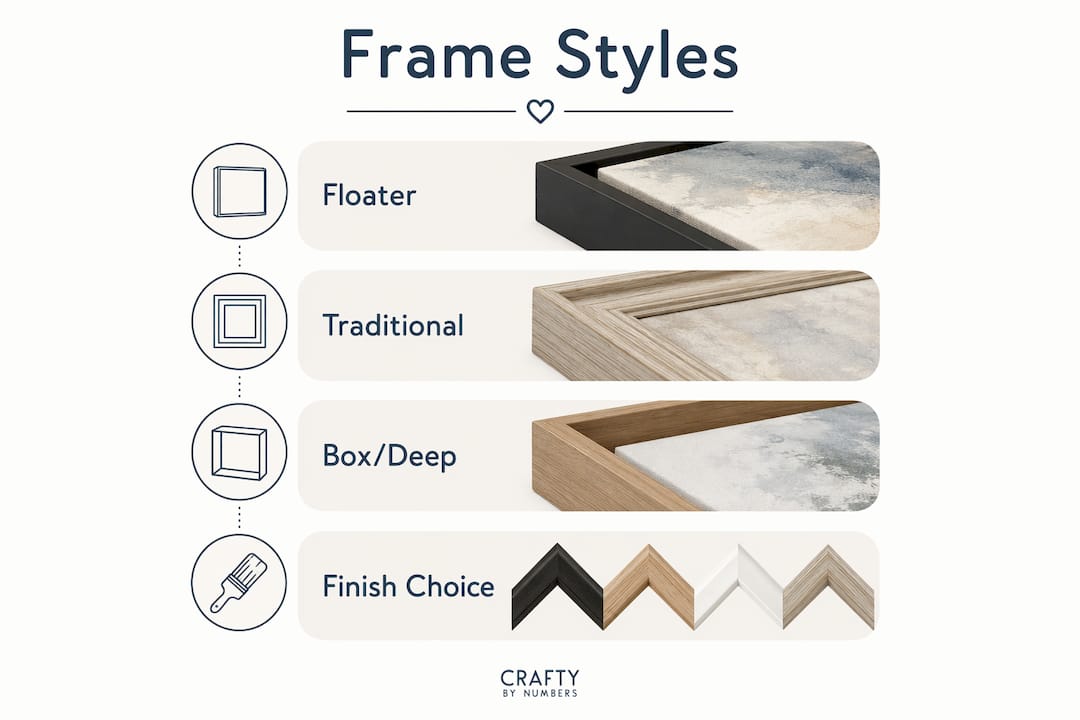
| Frame Style | Best For | Key Trait |
|---|---|---|
| Floater frame | Gallery-wrapped or painted-edge canvases | Leaves a 1/8–1/4 inch visible gap; full image stays exposed |
| Traditional (lip/rabbet) | Studio wraps or canvases needing overlap | Covers the outer edge; hides unpainted sides |
| Box / deep frame kit | Canvases 38 mm or thicker | Deeper rebate accommodates thick stretcher bars |
Floater frames are the most popular choice for paint-by-numbers canvases, and for good reason. The canvas appears to “float” inside the frame, preserving full-edge visibility while still giving the piece a finished, gallery-ready look. The gap also means the frame never obscures the colors along the canvas edge.
Traditional frames work when the canvas sides are raw or unfinished. The lip overlaps the edge and hides it cleanly. The tradeoff: if you painted those sides as part of your composition, a traditional frame buries that work.
Box or deep frames come into play when your canvas is thick. A Modern Frame Kit with a deep rebate handles gallery-wrapped canvases that standard frames simply cannot accommodate.
One more factor: finish. A matte frame recedes and lets the painting lead. A gloss or metallic finish draws attention to the frame itself. Match the frame weight and finish to your room’s scale — a delicate painting in a heavy ornate frame looks off-balance.
How do you measure your canvas for a frame?
Measurement mistakes are the most common framing error, and almost all of them come from measuring only width and height while ignoring depth.
- Measure the face: width first, then height, to the nearest 1/16 inch.
- Measure the depth: place a ruler against the side of the stretcher bar. Standard canvases run 18–25 mm deep; gallery-wrapped canvases are typically about 38 mm deep.
- Choose a frame with a deeper rebate than your canvas profile. If the canvas protrudes, the frame will not sit flat against the wall.
- For floater frames: plan for a 1/8–1/4 inch gap on all sides. Order a frame slightly larger than your canvas face dimensions to create that gap.
- Prep your workspace: lay a soft towel face-down to protect the painted surface, tape a small label on the back for orientation, and measure twice before ordering.
The stretcher bar depth is the measurement most beginners skip. Get it right and the frame fits perfectly. Miss it and you are returning a frame that cost you shipping twice.
| Canvas Type | Typical Depth | Recommended Rebate |
|---|---|---|
| Standard stretched | 18–25 mm | 25 mm minimum |
| Gallery wrap / deep edge | about 38 mm | 38 mm minimum |
| Floater frame gap target | N/A | 1/8–1/4 inch clearance |
What hardware actually holds the canvas in the frame?
How a frame grips the canvas depends on the frame style.
- Open-back frames overlap the front edge of the canvas with a lip. The canvas rests on the rabbet and clips hold it from the back.
- Floater frames mount entirely from the back. The canvas sits inside the frame with a visible gap, and screws or clips go through the frame’s inner wall into the stretcher bars.
- Offset clips are the go-to hardware for both styles. These small metal tabs screw into the frame’s inner edge and grip the stretcher bar without touching the painted surface at all.
- Z-bars offer a cleaner look for professional installs — two interlocking metal strips, one on the frame and one on the wall, that distribute weight evenly.
- Backing boards (foam core or archival board) close the open back, keeping dust and humidity away from the canvas.
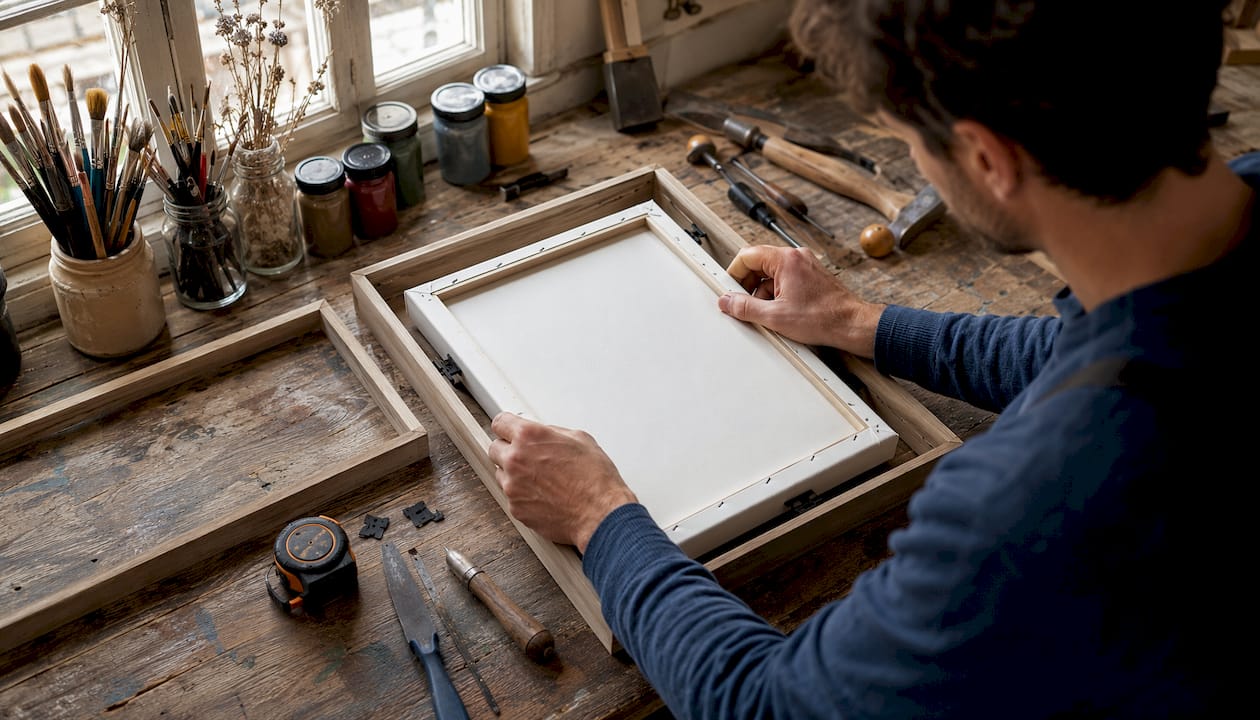
Pro Tip: Lay the frame face-down on a soft cloth, lower the canvas in painted-side down, and have a second person hold it steady while you attach the clips. Rushing this step is how painted surfaces get scratched.
If you are working with a rolled canvas rather than a pre-stretched one, unroll it with the painted side facing outward to reduce stress on the paint layer. Most people do the opposite instinctively, which risks cracking.
DIY framing vs professional framing: which makes sense?
For most paint-by-numbers hobbyists, DIY framing is the right call. A DIY Wooden Frame or ready-made floater kit costs a fraction of custom framing, and the process is straightforward for small-to-medium canvases.
- DIY advantages: lower cost, immediate turnaround, full control over finish and style.
- DIY works well for: small-to-medium canvases, simple floater styles, and hobbyists where budget is the main constraint.
- Professional advantages: precise centering (critical for floater frames where misalignment is obvious), custom rebate depths, conservation-grade backing, UV-protective glazing, and guaranteed hanging for heavy pieces.
- Choose professional framing when: the canvas is large, the piece has sentimental or monetary value, or the texture is complex enough that DIY mounting risks damage.
Typical DIY frame kits run from around $15–$50 for small-to-medium sizes. Professional custom framing for a comparable canvas can run $100–$300 or more depending on size and materials. For a hobbyist piece you painted for the joy of it, a well-chosen ready-made floater frame does the job beautifully.
How do you hang and care for a framed canvas?
- Use D-rings and picture wire for most canvases; two spaced wall fixings distribute weight better than a single hook.
- Choose wall anchors rated for the total weight of frame plus canvas — check the anchor packaging.
- Hang the center of the artwork at eye level, roughly 57–60 inches from the floor to the center of the piece.
- Avoid direct sunlight and high-humidity rooms like bathrooms. UV light fades acrylic paint over time, and humidity warps stretcher bars.
- Dust with a soft, dry cloth. Never spray cleaner directly onto the canvas surface.
- Check hanging hardware once a year. Wire stretches and D-ring screws loosen; a quick check takes two minutes and prevents a fall.
Large canvas paintings need two anchor points, not one. A single nail works for a small piece; anything over 16 x 20 inches deserves two fixings and a level.
Craftybynumbers’ recommendations for paint-by-numbers hobbyists
The practical path for most Craftybynumbers painters: hang the bare canvas for 1–2 weeks first. Then, if the piece calls for a frame, choose a floater for painted-edge canvases or a box/deep frame when the stretcher bars are 38 mm or thicker.
Pro Tip: Craftybynumbers has served 120,000+ customers, and the most common framing question is simply: “Do I have to?” The answer is no — but once you try a floater frame on a finished paint-by-numbers piece, most painters never go back to bare canvas.
Key Takeaways
Framing a finished canvas is a deliberate design choice that adds protection, visual weight, and room integration — not a requirement, but often the step that makes a paint-by-numbers piece feel complete.
| Point | Details |
|---|---|
| Try it bare first | Live with the unframed canvas for 1–2 weeks to judge light and decor before choosing a frame. |
| Measure depth, not just face | Standard canvases have a common range of depths; gallery wraps are usually thicker — pick a frame rebate deeper than your canvas profile. |
| Floater frames preserve edges | A floater leaves a small visible gap, showing the full image and protecting corners. |
| Offset clips protect the paint | These metal tabs secure the stretcher bars to the frame without touching the painted surface. |
| Craftybynumbers framing options | The Framed Canvas, DIY Wooden Frame, and Modern Frame Kit are all compatible with standard paint-by-numbers canvases. |
The frame is where the painting becomes the art
Most beginners treat framing as a chore at the end of a project. That is the wrong way to think about it. The frame is the last creative decision you make, and it shapes how everyone else sees the work. A floater frame on a vibrant paint-by-numbers piece does something a bare canvas cannot: it tells the room the painting belongs there.
What I find underestimated is how much the gap in a floater frame matters psychologically. That 1/8 inch of space between the canvas edge and the frame wall creates a subtle shadow that gives the painting depth. It looks intentional in a way that a traditional lip frame, which just covers the edge, does not. For the kind of detailed, color-rich canvases Craftybynumbers produces, that gap is worth the extra care in centering.
Start simple. A ready-made floater frame, offset clips, and a level. That is genuinely all most hobbyists need. Save the custom framing budget for the piece you are most proud of.
Ready to frame your paint-by-numbers canvas?
Craftybynumbers makes the framing decision easy for hobbyists who want a polished result without the guesswork of sourcing hardware separately. The Framed Canvas option delivers a ready-to-hang piece straight out of the kit — no measuring, no clips, no trips to the frame shop. For painters who prefer to frame at home, the DIY Wooden Frame is sized to fit standard Craftybynumbers canvases, and the Modern Frame Kit gives a floater-style finish with minimal effort.

With 120,000+ customers and kits designed specifically for display, Craftybynumbers has built framing compatibility into the product from the start. Browse the framing options and pick the one that fits your canvas, your wall, and your budget.
Useful sources
- Frame Guide — Blick Art Materials: authoritative overview of when and why to frame canvas art, including gallery-wrap considerations.
- How to Frame a Canvas Painting: A Complete Beginner’s Guide — Noho Art Gallery: practical hardware instructions including offset clip technique.
- The Complete Guide to Framing Canvas Art — Stelava: covers floater frame theory, finish choices, and visual integration.
- How to Frame Canvas Paintings — Laasya Art: curator-endorsed 1–2 week decision rule and frame-style guidance.
- How to Frame a Canvas Print — FramesPlus: depth measurement rules and rebate sizing for standard and gallery-wrapped canvases.
- Canvas Art: Quality, Sizing, and Custom Framing — Modern Memory Design: floater frame mechanics and centering precision advice.
- How to Frame Canvas Prints — FrameDestination: safe handling of rolled canvases and paint-layer protection tips.
- How to Frame a Canvas Painting at Home — Erica’s Art Studio: step-by-step DIY checklist for hobbyists using clips and backing boards.
- How to Frame Canvas Art: Step-by-Step DIY Guide — TheMasterCraft: accessible beginner walkthrough covering measurement, mounting, and hanging.
- How to Frame a Canvas: Display a Painting or Print — wikiHow: illustrated guide to store-bought frames, DIY floating frames, and wall-hanging hardware.
- Miniature Painting Set Up: 10 Essentials — Remerlinds: hobbyist workspace setup tips relevant to preparing a canvas for framing.
FAQ
Do I have to frame a finished canvas?
No. Gallery-wrapped canvases with painted sides can hang directly on the wall without a frame. Framing is a stylistic and protective choice, not a requirement.
What is a floater frame and why do painters prefer it?
A floater frame leaves a 1/8–1/4 inch gap between the canvas edge and the frame wall, so the full image stays visible. It protects corners without covering any painted surface.
How do I know what size frame to buy?
Measure the canvas face (width and height) and the side depth of the stretcher bars. Choose a frame with a rebate deeper than your canvas profile — standard canvases run 18–25 mm deep, gallery wraps are typically about 38 mm deep.
What are offset clips and do I need them?
Offset clips are small metal tabs that screw into the inner frame edge and grip the stretcher bars without touching the painted face. They are the recommended fastening method for finished canvases.
Can I frame a Craftybynumbers canvas at home?
Yes. Craftybynumbers canvases are compatible with standard floater frames and DIY kits. The DIY Wooden Frame and Modern Frame Kit are both sized for at-home use with no specialized tools required.
0 Kommentare